
Blog
How to Design a GMP Purified Water (PW) System: Advanced Engineering & Validation Considerations
Designing a GMP purified water system requires more than selecting RO and EDI. It demands an integrated approach covering process robustness, hygienic design, microbial control, and lifecycle validation. The following guide reflects best practices aligned with USP, EP, WHO GMP, ISPE Baseline Guide, and FDA expectations.
1. Define Critical Quality Attributes (CQA) & Critical Process Parameters (CPP)
A compliant design starts with linking water quality targets (CQA) to controllable system variables (CPP).
Typical CQAs:
- Conductivity (≤ 1.3 µS/cm @25°C)
- TOC (≤ 500 ppb or project-specific)
- Microbial count (≤ 100 CFU/mL, often tighter internal limits)
Key CPPs:
- RO recovery and rejection rate
- EDI current density and feed conductivity
- Loop velocity and temperature
- Sanitization parameters (time, temperature, ozone concentration)
👉 Design must ensure CPP stability under worst-case conditions.
2. Process Architecture: Redundancy and Stability
A modern pharmaceutical PW system typically adopts:
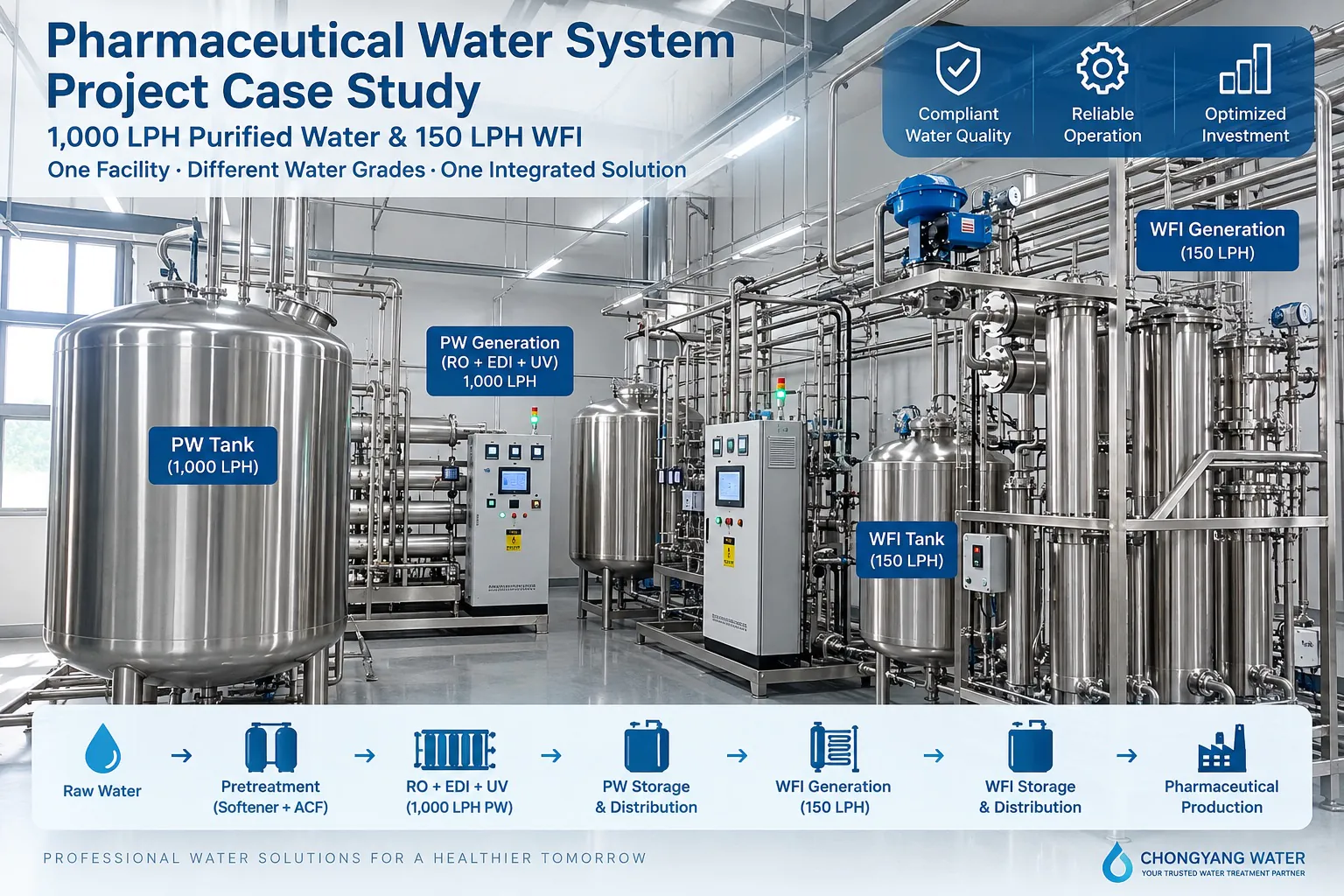
Pretreatment → Double-pass RO → EDI → UV → Final Filtration → Storage & Loop
Advanced considerations:
- Double-pass RO reduces ionic load and improves EDI stability
- EDI feed conductivity control (< 10–20 µS/cm) is critical for stable performance
- Optional degassing (CO₂ removal) improves resistivity and EDI efficiency
👉 System design should minimize fluctuations entering EDI.
3. Hydraulic & Loop Design (Fluid Mechanics Perspective)
The distribution loop must be engineered as a controlled hydraulic system.
Key design parameters:
- Velocity: 1.0–1.5 m/s (turbulent flow, Reynolds > 4000)
- Pressure balance: Avoid dead zones at low-pressure nodes
- Pipe diameter optimization: Prevent excessive residence time
- Return loop temperature uniformity: ±2°C deviation max (hot systems)
Dead-leg control:
- Length ≤ 1.5 × pipe diameter
- Avoid branch stagnation at instruments and valves
👉 Poor hydraulics is the primary driver of biofilm formation.
4. Materials & Surface Engineering
Material selection must consider corrosion resistance, cleanability, and extractables.
- SS316L (EN 1.4404) mandatory for wetted parts
- Surface roughness:
- Standard: Ra ≤ 0.6 µm
- High-end: Ra ≤ 0.4 µm (electropolished)
- Passivation: Nitric or citric acid treatment required
- Elastomers: FDA-compliant EPDM/PTFE, low extractables
👉 Surface energy and roughness directly influence microbial adhesion.
5. Sanitization Philosophy & Microbial Control
Microbial control must be designed, not corrected later.
Preferred strategies:
- Hot water sanitization (70–85°C): thermal kill + biofilm prevention
- Ozone (ambient systems): continuous or periodic dosing (0.02–0.05 ppm typical loop level)
- UV (254 nm / 185 nm): microbial and TOC control
Critical factors:
- Complete loop exposure
- Defined hold time
- Verified destruction (e.g., UV ozone destruct before POU)
👉 Sanitization must be fully integrated into control logic and validation.
6. Instrumentation & Data Integrity (21 CFR Part 11 Context)
Instrumentation must support real-time release and audit traceability.
Core instruments:
- Conductivity (product + return loop)
- TOC analyzer (online, critical systems)
- Temperature (multiple loop points)
- Flow & pressure transmitters
Control system:
- PLC + SCADA with audit trail
- Alarm management (ISA-18.2 principles)
- Data integrity: ALCOA+ (Attributable, Legible, Contemporaneous, Original, Accurate)
👉 Inspectors increasingly focus on data trends and integrity, not just hardware.
7. Storage Tank & Gas-Liquid Interface Control
The storage tank is a high-risk microbial zone.
Design requirements:
- Spray ball coverage (CIP/SIP validated)
- Hydrophobic vent filter (0.2 µm) with integrity testing
- Nitrogen blanketing (optional) to reduce oxygen ingress
- No stagnant zones inside tank geometry
👉 Air-water interface control is critical for long-term microbial stability.
8. Validation Strategy (Lifecycle Approach)
Validation is not a phase—it is a lifecycle.
- DQ: Risk-based design review (URS compliance, GMP alignment)
- IQ: Installation vs. as-built P&ID, weld traceability
- OQ: Functional testing (alarms, interlocks, sanitization cycles)
- PQ: Long-term performance (minimum 2–4 weeks trending)
Sampling strategy:
- Worst-case points (loop end, low-flow areas)
- Dynamic vs. static sampling comparison
👉 Trending consistency is more important than single compliance results.
9. Risk Management (ICH Q9 Approach)
Apply formal risk tools:
- FMEA (Failure Mode & Effects Analysis)
- Identify high-risk nodes: dead legs, low velocity, temperature drops
- Define mitigation: design change, monitoring, SOP
👉 Risk-based design is expected by regulators.
Conclusion
A GMP purified water system is a controlled, validated, and continuously monitored process utility. The optimal design integrates:
- Stable process train (RO + EDI)
- Engineered hydraulics (no stagnation)
- Sanitary materials and finishes
- Integrated sanitization strategy
- Data-driven validation and monitoring
The goal is not just to meet specifications—but to maintain a state of control throughout the system lifecycle.
Looking for a GMP-compliant purified water system?
We provide complete solutions including design, engineering, validation (DQ/IQ/OQ/PQ), and long-term technical support.
More Posts