
Blog
How High Temperature RO and EDI Improve Purified Water Quality in Pharma Plants
High temperature RO and EDI systems improve purified water quality through hot water sanitization, stable conductivity control, reduced microbial risk, and reliable long-term operation in high-purity water treatment plants.
1. Introduction
Purified water quality is critical in modern pharma plants, where stable conductivity, low microbial risk, reliable sanitization, and continuous operation are required. Conventional ambient-temperature RO systems can produce qualified purified water, but they may face higher biofilm risk and more frequent chemical sanitization in demanding sanitary environments. This is why high temperature RO and EDI systems are increasingly used for purified water generation.
By combining hot water sanitizable reverse osmosis with electrodeionization, the system provides stable purified water quality, reduces microbial contamination risk, and integrates well with sanitary storage and distribution loops.
2. What Is a High Temperature RO + EDI Purified Water System?
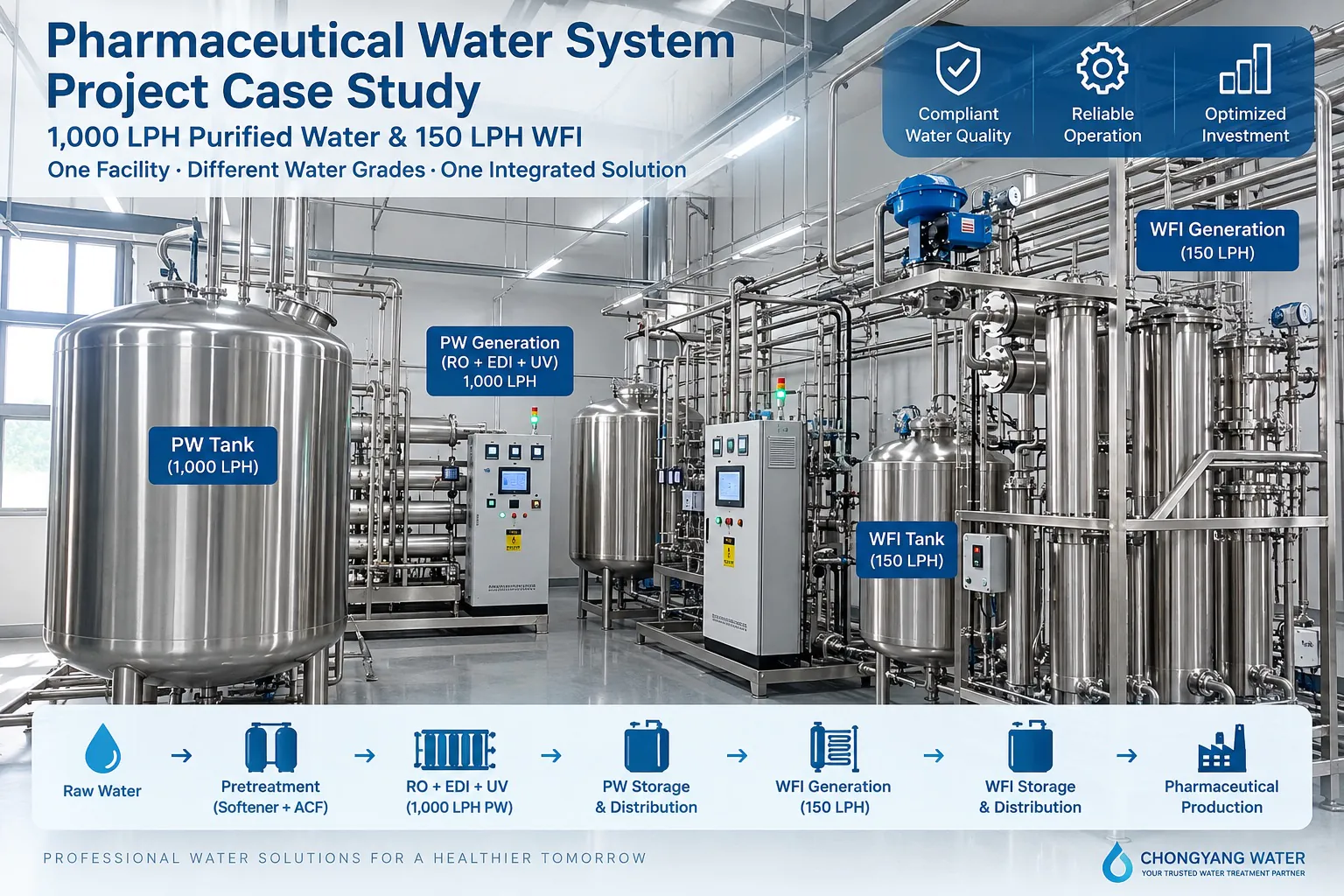
A high temperature RO + EDI purified water system is an integrated water treatment package using hot water sanitizable RO membranes followed by continuous EDI polishing. A typical system includes pretreatment, high temperature RO, EDI modules, UV sterilization, final filtration, purified water tank, and sanitary distribution loop.
Compared with conventional RO + EDI skids, the high temperature RO section is designed to tolerate elevated sanitization temperatures, commonly around 80°C depending on membrane type and system design. This helps control microbial growth in the RO section, which is often a sensitive point in purified water systems.
3. Applications
High temperature RO and EDI systems are widely used in pharma plants for purified water generation, liquid preparation, equipment washing, laboratory supply, clean utility systems, and sanitary process water applications. They are especially suitable for facilities requiring hot water sanitization, strict microbial control, and stable long-term operation.
4. Key Features
| Feature | Engineering Value |
|---|---|
| Hot Water Sanitizable RO | Reduces microbial growth and biofilm risk inside the RO membrane section. |
| EDI Continuous Polishing | Produces stable low-conductivity purified water without chemical resin regeneration. |
| Lower Microbial Risk | Improves hygienic control in critical water contact areas. |
| Reduced Chemical Use | Hot water sanitization helps reduce dependence on repeated chemical sanitizing. |
| Sanitary Construction | SS316L contact parts, sanitary piping, low dead leg design, and orbital welding options. |
| PLC + HMI Control | Supports monitoring of conductivity, pressure, flow, temperature, and sanitization steps. |
5. How It Works
The process starts with pretreatment, which may include multimedia filtration, activated carbon filtration, softening or antiscalant dosing, and cartridge filtration. Pretreatment protects the downstream membranes from fouling, scaling, chlorine damage, and suspended solids.
The pretreated water then enters the high temperature RO unit, where dissolved salts, particulates, colloids, microorganisms, and organic contaminants are reduced. During scheduled sanitization, the RO membrane skid, piping, valves, and instruments are exposed to hot water to control microbial growth.
After RO, the permeate enters the EDI module for final ionic polishing. EDI uses ion exchange media, ion-selective membranes, and direct current to continuously remove residual ions. The outlet water may then pass through UV sterilization and final filtration before entering the purified water tank and sanitary distribution loop.
6. FAQ
Why use high temperature RO instead of standard RO?
High temperature RO allows hot water sanitization of the RO section, reducing microbial growth and biofilm risk, which helps maintain stable purified water quality.
What does EDI do after RO?
EDI continuously removes residual ions after RO, helping the system achieve stable conductivity without conventional acid and caustic regeneration.
Can this system connect with a hot water sanitized loop?
Yes. High temperature RO + EDI systems are commonly integrated with SS316L purified water tanks, heat exchangers, and continuously circulating sanitary distribution loops.
7. Conclusion + CTA
A high temperature RO + EDI purified water system improves water quality by combining hot water sanitizable membrane separation with continuous electrodeionization polishing. It supports stable conductivity, lower microbial risk, reduced chemical sanitization, and reliable long-term operation.
Need a Customized High Temperature RO + EDI System?
CHONGYANG provides customized purified water generation systems with hot water sanitizable RO, EDI polishing, SS316L sanitary piping, PLC/HMI control, and project documentation support.
Send us your required capacity, feed water quality, sanitization method, and project layout for a tailored technical proposal.
More Posts