
Blog
Introduction
How much does a pharmaceutical purified water system cost?
For pharmaceutical manufacturers, engineering contractors, and procurement managers, this is one of the most important questions when planning a new production facility or upgrading an existing water treatment system.
However, the price of a pharmaceutical purified water system depends on much more than its production capacity.
Two systems rated at 1,000 liters per hour (LPH) may have significantly different prices because of their treatment processes, hygienic design, automation requirements, storage and distribution configurations, and qualification documentation.
For example, a basic reverse osmosis system designed for general industrial applications is fundamentally different from a pharmaceutical purified water system engineered for controlled production, sanitary distribution, microbiological management, and GMP-oriented operation.
This article explains the typical cost ranges, major pricing factors, equipment configurations, and engineering considerations involved in purchasing a pharmaceutical purified water system.
1. What Is the Typical Cost of a Pharmaceutical Purified Water System?
The initial investment depends on the required production capacity and scope of supply.
The following table provides illustrative budget ranges for pharmaceutical purified water generation equipment.
| Production Capacity | Indicative Equipment Budget (USD) | Typical Application |
|---|---|---|
| 250–500 LPH | $15,000–$40,000 | Laboratories, pilot production, small pharmaceutical facilities |
| 1,000 LPH | $25,000–$65,000 | Small and medium pharmaceutical production |
| 2,000 LPH | $40,000–$90,000 | Pharmaceutical manufacturing plants |
| 3,000–5,000 LPH | $65,000–$160,000 | Medium to large pharmaceutical facilities |
| 10,000 LPH | $120,000–$280,000 | Large pharmaceutical manufacturing plants |
Budgetary examples only, not verified market quotations. Assumes a broadly defined pharmaceutical PW generation scope. Storage/distribution loops, extensive qualification, installation, taxes and freight may be excluded. Actual prices require a project-specific quotation.
These ranges should not be interpreted as fixed market prices. A highly automated system with premium instrumentation, advanced sanitization and extensive documentation may exceed the indicated budget.
The most important principle is that pharmaceutical water system pricing should be evaluated according to the complete technical scope—not capacity alone.
2. What Equipment Is Included in a Pharmaceutical Purified Water System?
A typical pharmaceutical purified water generation system may include several treatment stages.
Typical Pharmaceutical PW Treatment Process
Pretreatment System
Pretreatment protects downstream RO membranes and other purification equipment.
Depending on raw water quality, the system may include multimedia filtration, activated carbon filtration, water softening, chemical dosing and cartridge filtration.
Pretreatment requirements influence equipment size, materials, automation and maintenance costs.
Reverse Osmosis System
Reverse osmosis is one of the principal purification technologies used in pharmaceutical PW generation.
A pharmaceutical project may require single-pass RO, double-pass RO or RO combined with EDI.
Double-pass RO generally increases equipment investment because it requires additional membrane elements, pressure vessels, pumps, instrumentation and controls.
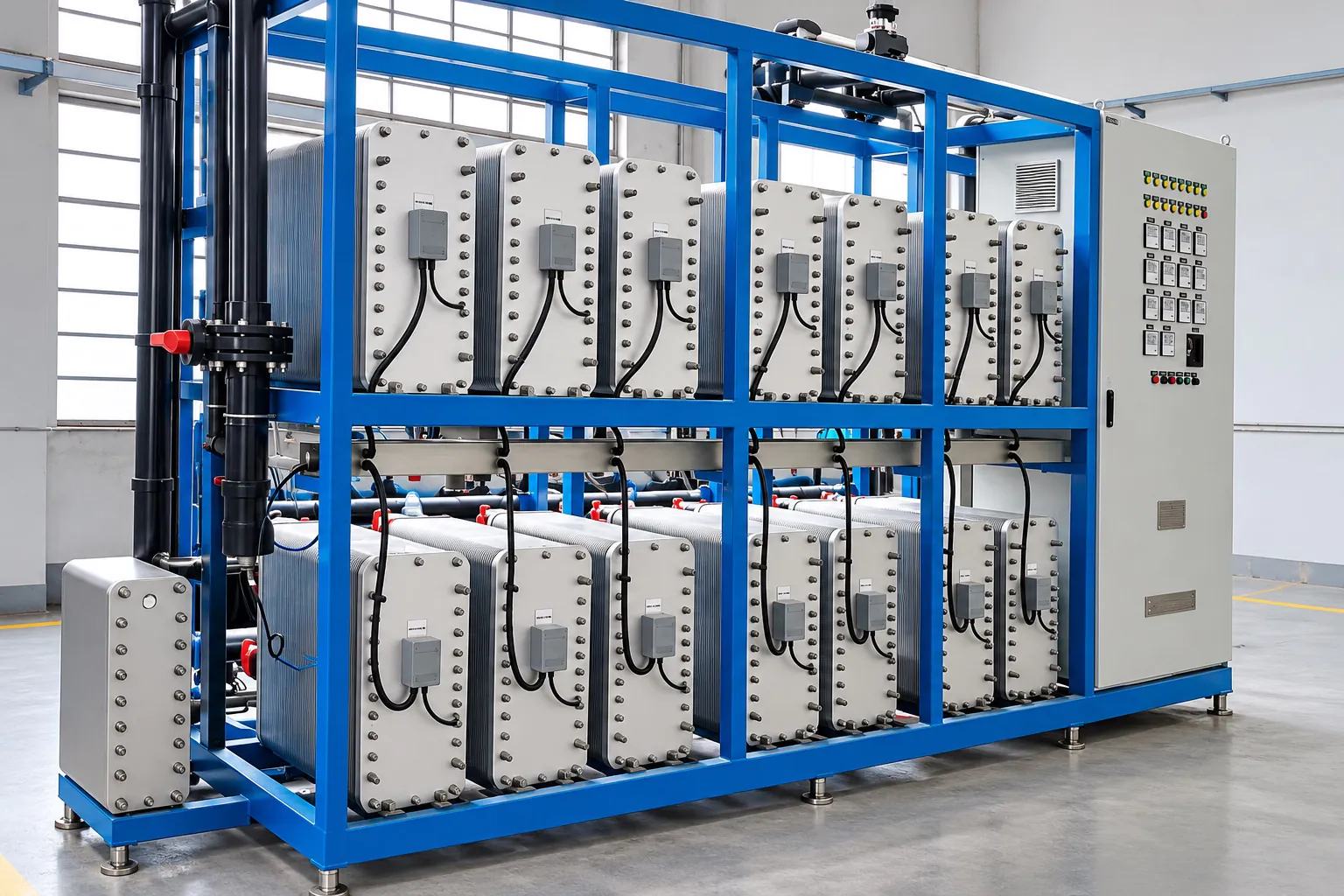
Electrodeionization (EDI)
EDI provides continuous ionic removal without conventional mixed-bed chemical regeneration.
An RO + EDI configuration is commonly considered when stable low-conductivity water is required.
However, EDI performance depends on appropriate feed-water quality, including hardness, carbon dioxide and other operating parameters.
Storage and Distribution
The PW storage tank and distribution loop are critical parts of a pharmaceutical water system.
They may include SS316L storage tanks, sanitary circulation pumps, hygienic piping, UV equipment, heat exchangers, vent filters and online monitoring instruments.
These components can represent a substantial portion of the total project investment.
3. What Factors Affect Pharmaceutical Purified Water System Cost?
3.1 Production Capacity
A 5,000 LPH pharmaceutical purified water system generally requires larger pumps, membrane arrays, piping, filtration equipment and electrical components than a 500 LPH system.
However, the cost per liter of installed production capacity does not necessarily increase proportionally.
Larger systems may benefit from economies of scale.
3.2 Water Quality Requirements
The required water grade determines the purification and control strategy.
For example, a system intended to produce USP Purified Water must be engineered to meet the applicable compendial requirements and maintain appropriate chemical and microbiological quality.
The specified water grade does not automatically mandate a particular RO or EDI arrangement.
3.3 Material Selection
Material selection has a significant impact on equipment cost.
| Component | Common Material Options | Cost Consideration |
|---|---|---|
| Pretreatment vessels | FRP, SS304, SS316L | Stainless steel typically increases initial cost |
| RO piping | UPVC, SS304, SS316L | Depends on pressure, chemistry and hygienic requirements |
| PW storage tank | SS316L | Sanitary design and surface finish affect cost |
| PW distribution piping | SS316L | Welding, electropolishing and installation increase investment |
| Sanitary valves | Manual or automated hygienic valves | Pneumatic automation increases cost |
For pharmaceutical storage and distribution systems, SS316L is commonly selected for product-contact surfaces.
Additional requirements such as electropolishing, surface roughness verification, orbital welding and material traceability can further increase project cost.
3.4 Instrumentation and Automation
Instrumentation can include conductivity sensors, flowmeters, pressure transmitters, temperature sensors, tank level transmitters and TOC analyzers where required.
The automation system may incorporate Siemens PLC/HMI, alarms, operating trends, access control and SCADA integration.
Advanced data integrity requirements, including applicable electronic records and electronic signatures controls, may require additional software, configuration, testing and documentation.
3.5 Sanitization Method
Common pharmaceutical PW sanitization strategies include hot-water sanitization, ozone sanitization and other validated approaches.
A hot-water sanitization system may require heating equipment, heat exchangers, temperature monitoring, automated valves, insulation and a suitable control sequence.
The sanitization strategy should be determined during engineering design rather than added after equipment manufacture.
4. How Much Do PW Storage and Distribution Systems Add to the Cost?
One of the most common purchasing mistakes is comparing a quotation for a PW generation skid with another quotation covering a complete pharmaceutical water system.
Consider two proposals:
Supplier A: 1,000 LPH RO + EDI generation equipment only.
Supplier B: 1,000 LPH RO + EDI, sanitary PW tank, distribution skid, hot-water sanitization, online monitoring, and qualification documentation.
Even though both proposals state “1,000 LPH Purified Water System,” their scope and cost may be substantially different.
Distribution-loop cost depends on:
- Storage tank volume and hygienic construction
- Total pipeline length and pipe diameter
- Number of points of use
- Circulation flow and hydraulic design
- Installation and welding requirements
- Sanitization and monitoring provisions
For a pharmaceutical facility with multiple production rooms or floors, the distribution system can be a major engineering and installation expense.
5. Case Study: A 1,000 LPH Pharmaceutical PW System
Consider a pharmaceutical manufacturer planning a 1,000 LPH purified water generation system for production and equipment washing.
The customer requires a hygienic PW storage and distribution system with automated hot-water sanitization.
An illustrative configuration is:
| Item | Proposed Engineering Configuration |
|---|---|
| PW production capacity | 1,000 LPH |
| Pretreatment | Multimedia filter, activated carbon, softener and cartridge filter |
| Purification | Double-pass RO + EDI |
| PW storage | SS316L sanitary storage tank |
| Distribution | SS316L sanitary circulation loop |
| Sanitization | Automated hot-water sanitization |
| Control | PLC/HMI |
| Monitoring | Conductivity, temperature, pressure and flow |
| Documentation | FAT/SAT and agreed qualification support |
The exact tank capacity, distribution-loop length and sanitization parameters would be finalized from the URS.
Where Does the Budget Go?
Illustrative Project Budget Allocation
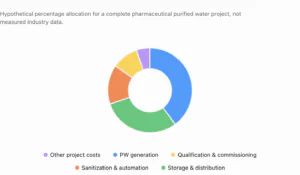
Hypothetical percentage allocation for a complete pharmaceutical purified water project, not measured industry data.
Illustrative planning model only. Actual allocations depend on project scope and are not industry benchmarks.
This example demonstrates why a complete pharmaceutical PW project should be evaluated as an integrated system rather than a collection of independent equipment prices.
6. Why Are Some Pharmaceutical Water Systems Much Cheaper?
A lower quotation does not automatically mean poor quality. However, it may reflect a different scope of supply.
For example, a lower-priced system may exclude storage tanks, distribution piping, hot-water sanitization, premium instruments, installation, commissioning or qualification documentation.
Other price differences may result from local component sourcing, automation complexity, manufacturing methods or engineering specifications.
When comparing suppliers, pharmaceutical manufacturers should request a detailed technical comparison that identifies both included and excluded items.
The objective is not simply to select the lowest equipment price, but to understand the total cost of obtaining a reliable and maintainable pharmaceutical water system.
7. What Are the Operating Costs of a Pharmaceutical Purified Water System?
Initial equipment cost is only one part of the total cost of ownership.
Typical operating expenses include electricity, feed water, wastewater disposal, pretreatment chemicals, cartridge filters, RO membrane cleaning, instrument calibration, sanitization and routine maintenance.
RO recovery rate can also influence operating costs.
For example, at an assumed RO recovery of 70%, producing 1,000 liters of permeate requires approximately 1,429 liters of RO feed water, excluding other plant losses and downstream process recovery effects.
Actual operating costs depend on feed-water quality, treatment configuration, production hours, utility prices and maintenance requirements.
A technically optimized system should therefore balance initial capital expenditure (CAPEX) and long-term operating expenditure (OPEX).
8. How Can You Obtain an Accurate Pharmaceutical Water System Quotation?
A reliable quotation requires more than the requested production capacity.
The customer should provide a raw-water analysis, required pharmaceutical water grade, production capacity, operating schedule, tank volume, distribution-loop information, sanitization requirements and automation preferences.
For a new pharmaceutical facility, a User Requirement Specification (URS) is particularly useful.
It allows the supplier to establish a process flow diagram, equipment list, preliminary P&ID, utility requirements, scope of supply and qualification responsibilities.
A clear URS also reduces technical misunderstandings during procurement and project execution.
Frequently Asked Questions (FAQ)
How much does a 1,000 LPH pharmaceutical purified water system cost?
An illustrative initial equipment budget may be $25,000–$65,000 for a defined pharmaceutical PW generation scope. A complete project with storage, distribution, sanitization, installation and qualification can cost substantially more. A formal quotation is needed for reliable pricing.
Is RO + EDI necessary for every pharmaceutical purified water system?
No. RO + EDI is one possible configuration. The final process should be selected according to raw-water quality, required water grade, operating conditions and the validated control strategy.
Is a pharmaceutical purified water system more expensive than an industrial RO system?
Often, yes. Pharmaceutical applications may require additional hygienic design, sanitary materials, microbiological controls, documentation, monitoring and qualification activities.
Does the equipment price include GMP qualification?
Not necessarily. DQ, IQ, OQ and PQ documentation or execution support should be clearly defined in the supplier's scope of supply. The manufacturer retains responsibility for the facility's quality system and qualification strategy.
Can one purified water system supply several pharmaceutical production areas?
Yes, provided the generation capacity, storage volume, distribution hydraulics and water quality controls are appropriately designed. The number and location of points of use should be confirmed during engineering.
How long does a pharmaceutical purified water system last?
Service life depends on design, operating conditions, water quality, maintenance and component selection. Pumps, membranes, filters, instruments and other components have different maintenance and replacement requirements.
Conclusion: Evaluate the Complete System, Not Just the Price
The cost of a pharmaceutical purified water system depends on production capacity, raw-water quality, treatment configuration, sanitary materials, storage and distribution, automation, sanitization and qualification requirements.
A 1,000 LPH pharmaceutical PW system cannot be evaluated accurately based on its rated capacity alone.
For pharmaceutical manufacturers, the most effective procurement strategy is to define the required water grade and complete project scope before comparing supplier quotations.
This approach helps avoid unexpected costs, technical gaps and expensive modifications during installation and commissioning.
Get a Customized Pharmaceutical Water System Quotation
CHONGYANG WATER specializes in engineered pharmaceutical water treatment solutions, including Purified Water systems, double-pass RO, RO + EDI, WFI generation, sanitary storage and distribution, hot-water sanitization and PLC/HMI automation.
Whether your project requires a compact 500 LPH PW system or a large-scale pharmaceutical water generation and distribution system, our engineering team can develop a configuration based on your specific requirements.
Send us your raw-water analysis, required capacity, water quality standard, tank volume, distribution-loop details and URS for a customized technical proposal and quotation.
Explore CHONGYANG WATER →