
Blog
FDA, USP, cGMP or GMP for Pharmaceutical Water?
Introduction
When planning a pharmaceutical water system, one of the most common questions from engineering teams and equipment buyers is:
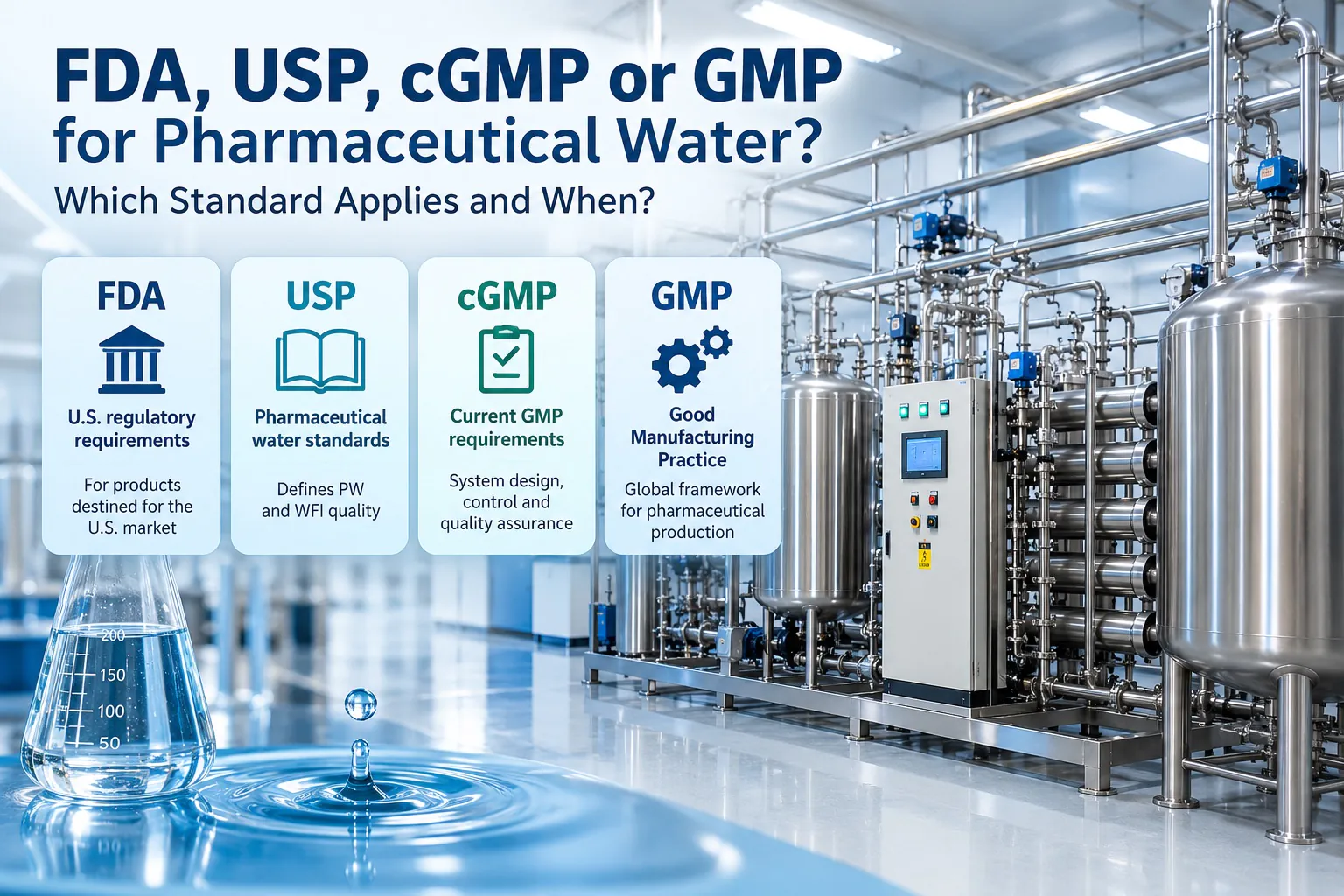
At first glance, these terms appear to describe four competing standards. In practice, they serve different purposes and often work together rather than replacing one another.
For example, a pharmaceutical factory producing medicines for the U.S. market may specify USP Purified Water or Water for Injection (WFI) as the required water grade while designing, operating, documenting and maintaining the water system within an applicable CGMP regulatory framework.
Therefore, the correct engineering question is not simply: “Which standard should I choose?”
1. First, Understand the Difference
The four terms do not have the same function. Understanding their roles is the first step in selecting the correct pharmaceutical water system requirements.
| Term | What It Represents | Main Relevance to Pharmaceutical Water |
|---|---|---|
| FDA | U.S. regulatory authority | U.S. regulatory and inspection context |
| USP | United States Pharmacopeia | Pharmaceutical water grades, specifications and compendial framework |
| cGMP / CGMP | Current Good Manufacturing Practice | Current manufacturing, control, documentation and quality-system requirements |
| GMP | Good Manufacturing Practice | Broader framework for consistent pharmaceutical manufacturing and quality control |
2. When Should You Consider FDA Requirements?
FDA should be considered when the pharmaceutical facility, manufacturing operation or finished product is subject to U.S. regulatory requirements, particularly when products are intended for the United States.
For pharmaceutical water engineering, the practical implications can include appropriate system design, validation, monitoring, documentation, maintenance and control under the applicable U.S. CGMP requirements.
Example — Pharmaceutical Facility for the U.S. Market
| Water Quality | USP Purified Water |
| Manufacturing Framework | Applicable U.S. CGMP requirements |
| System | Pretreatment + Double-Pass RO + EDI + PW Tank + Distribution Loop |
| Control | PLC/HMI with alarms, trends and defined user access |
| Qualification | DQ / IQ / OQ / PQ according to the project's validation strategy |
In this case, USP and FDA/CGMP are not competing selections. They address different layers of the same pharmaceutical water project.
3. When Should You Choose USP?
USP becomes particularly relevant when the required pharmaceutical water grade is specified according to the United States Pharmacopeia.
Two frequently encountered bulk pharmaceutical water grades are Purified Water (PW) and Water for Injection (WFI).
The engineering team must translate this requirement into a complete treatment, storage, distribution and control strategy.
The exact process should be selected according to:
- Raw-water analysis
- Required pharmaceutical water grade
- Production capacity and operating hours
- Microbiological risk
- Sanitization method
- Storage and distribution-loop configuration
- Applicable project and regulatory requirements
4. When Should You Use cGMP?
The “c” in cGMP / CGMP means current. In a U.S. regulatory context, CGMP emphasizes that pharmaceutical manufacturing and control practices must satisfy applicable current requirements.
For pharmaceutical water engineering, this moves the discussion beyond the final conductivity reading. The system must be capable of reliably and consistently producing, storing and distributing water of the required quality.
5. What About GMP?
GMP is the broader Good Manufacturing Practice concept used internationally, although the precise legal and technical requirements depend on the applicable jurisdiction and regulatory framework.
For pharmaceutical water, GMP thinking applies to the entire water path, including chemical and microbiological quality during generation, storage and distribution.
Typical GMP-Oriented Project
The engineering design may incorporate SS316L product-contact piping, hygienic fittings, controlled dead legs, drainability, continuous circulation, appropriate surface finish, sanitization provisions, calibrated instrumentation and qualification documentation. Precise requirements must come from the applicable regulatory framework and the customer's URS.
6. GMP vs cGMP: Are They Completely Different?
Not really. They share the same fundamental objective: consistent manufacturing and control of pharmaceutical products to the required quality standard.
The terminology becomes important because different markets and regulators may use different regulatory structures. For an equipment supplier, asking only “GMP or cGMP?” does not provide enough engineering information.
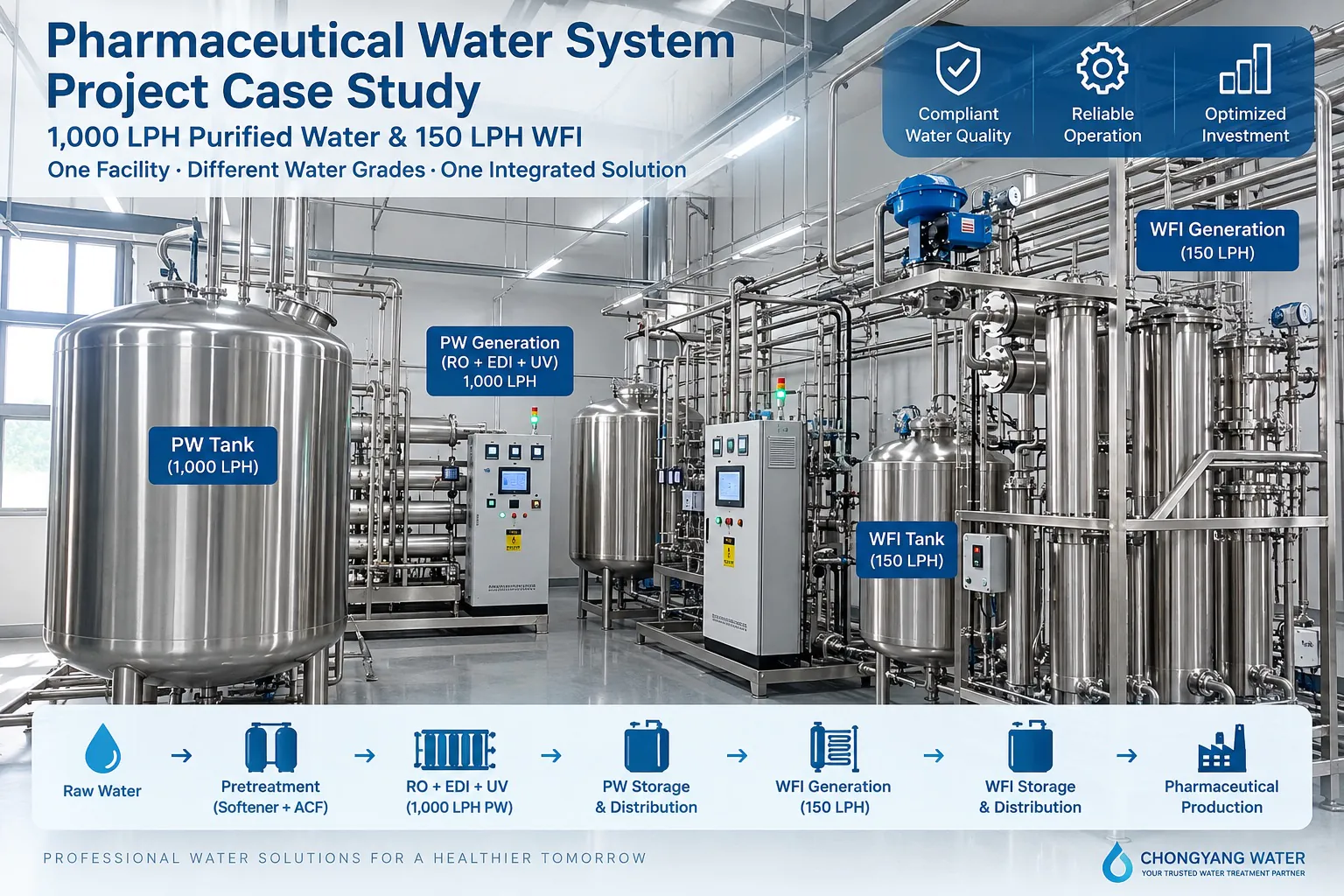
7. Case Study: How the Selection Works in a Real Project
Consider a new pharmaceutical facility requiring 1,000 LPH Purified Water, a 300 L PW storage tank, sanitary distribution loop, hot-water sanitization and PLC/HMI control, with finished pharmaceutical products intended for the U.S. market.
Products for the U.S. market require consideration of the applicable FDA regulatory framework and U.S. CGMP requirements.
If the process requires USP Purified Water, the PW system must consistently deliver the specified water quality.
Select the treatment process according to raw-water quality and finished-water requirements.
Design storage and circulation to preserve water quality after generation.
Define documentation, calibration, FAT/SAT and DQ/IQ/OQ/PQ requirements according to project scope.
This process configuration is an engineering response to the source-water and finished-water requirements. It is not created simply by attaching an “FDA” label to the equipment.
8. Do Not Select the Standard Based Only on Equipment
A common procurement mistake is to send an inquiry stating:
This information is insufficient for accurate pharmaceutical engineering. The supplier should additionally confirm:
- What pharmaceutical product will be manufactured?
- What is the target market?
- Which pharmacopoeia applies?
- Is PW or WFI required?
- What is the raw-water analysis?
- How many points of use are required?
- What sanitization method is required?
- What qualification package is required?
9. The Most Important Core Point of Each Framework
A practical way for pharmaceutical engineers and procurement teams to remember the differences is:
| Framework | Core Engineering Question |
|---|---|
| FDA | Is the project operating within an applicable U.S. regulatory context? |
| USP | What pharmaceutical water grade and compendial quality requirements apply? |
| cGMP / CGMP | How will the system consistently operate, control, document and maintain the required quality under current requirements? |
| GMP | How will pharmaceutical manufacturing quality be consistently assured throughout the process? |
FAQ
Is FDA the same as USP?
No. FDA is a U.S. regulatory agency, while USP develops compendial standards, including pharmaceutical water monographs and related chapters.
Should I choose USP or cGMP for a pharmaceutical water system?
They are not direct alternatives. USP can define the required pharmaceutical water quality, while CGMP addresses the broader manufacturing and quality-control framework.
Does “GMP water system” define a specific conductivity?
Not by itself. GMP is not a single water-quality monograph. Specific water-quality requirements should be established from the applicable pharmacopoeia, product requirements, regulatory framework and URS.
Is USP Purified Water suitable for feeding a WFI generator?
It can be, depending on the WFI generator design and its specified feed-water requirements. The upstream PW system should provide stable chemical and microbiological feed conditions.
Does pharmaceutical water compliance end at the RO or EDI outlet?
No. Storage and distribution are also critical because water quality must be maintained after generation and throughout the distribution system.
Do all pharmaceutical projects require the same PW process?
No. A system might use double-pass RO, RO + EDI or another justified configuration. Raw-water chemistry, required water grade, microbial-control strategy and project requirements determine the final process.
Conclusion: Start with the Market, Then the Water Grade
Choosing requirements for a pharmaceutical water system should not begin by selecting FDA, USP, cGMP or GMP as if they were four competing equipment standards.
For a U.S.-market pharmaceutical project, FDA and applicable CGMP requirements may form part of the regulatory framework, while USP may define the required pharmaceutical water grade and compendial quality requirements.
Regardless of the framework, the engineering objective remains consistent: the pharmaceutical water system must reliably generate, store and distribute water suitable for its intended use.
Planning a Pharmaceutical PW or WFI Project?
CHONGYANG WATER provides engineered pharmaceutical water solutions including Purified Water systems, double-pass RO, RO + EDI, WFI generation, PW/WFI storage and distribution, hot-water sanitization, CIP/SIP interfaces, PLC/HMI automation and qualification documentation support.
When sending an inquiry, provide your target market, applicable pharmacopoeia, required water grade, raw-water analysis, capacity, points of use, sanitization requirements and URS. The system can then be engineered around the actual regulatory, water-quality and production requirements rather than simply attaching a “GMP” or “FDA” label to the equipment.
Discuss Your Pharmaceutical Water Project →More Posts