
Blog
What Is an EDI Module and How Does It Work in Water Treatment?
Introduction
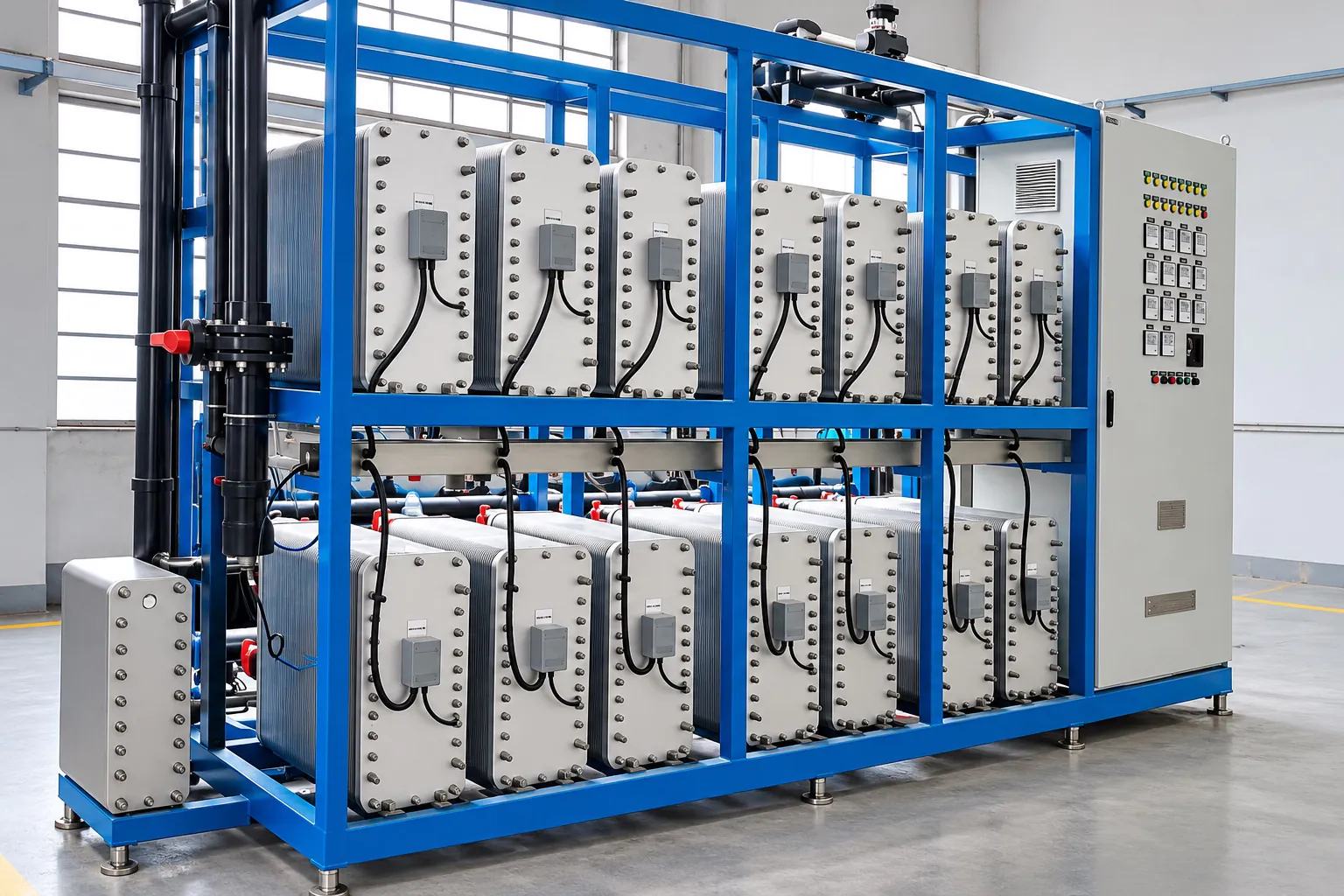
An EDI module (Electrodeionization Module) is an important component in modern high purity water treatment systems. It combines ion exchange resins, ion-selective membranes, and direct current (DC) electricity to continuously remove dissolved ions from water.
Unlike conventional mixed-bed ion exchange systems, EDI technology normally operates without chemical regeneration, reducing chemical handling and supporting continuous water production.
EDI modules are widely used in pharmaceutical purified water systems, electronics manufacturing, boiler feedwater treatment, and industrial ultrapure water applications.
This article explains how EDI works, its technical requirements, typical RO + EDI configurations, and key considerations for system design and maintenance.
1. What Is an EDI Module?
An EDI module is an electrically driven water purification device designed to remove residual dissolved ions from pretreated water, typically reverse osmosis (RO) permeate.
Its main components include:
- Ion Exchange Resins: Facilitate ionic transport and removal.
- Cation Exchange Membranes: Selectively transport positively charged ions.
- Anion Exchange Membranes: Selectively transport negatively charged ions.
- Electrodes: Generate the DC electric field required for ion migration.
- Dilute and Concentrate Channels: Separate purified water from the removed ions.
Under suitable operating conditions, an EDI system can produce high purity water with resistivity approaching 18.2 MΩ·cm at 25°C.
Actual performance depends on feedwater quality, module selection, operating conditions, and system design.
2. How Does EDI Work?
Electrodeionization combines three processes: ion exchange, ion migration, and continuous electrical regeneration.
First, RO permeate enters the EDI module. Dissolved ions interact with ion exchange resins inside the dilute compartments.
When DC voltage is applied, positively charged ions migrate toward the cathode, while negatively charged ions migrate toward the anode.
Selective membranes allow these ions to move into concentrate channels, where they are carried away by a separate water stream.
The electric field also supports continuous regeneration of the ion exchange media, eliminating the need for conventional acid and caustic regeneration cycles.
3. Typical RO + EDI Water Treatment Process
EDI modules are generally installed downstream of reverse osmosis because they require low-hardness, low-salinity feedwater.
Typical RO + EDI Process Flow
Water Tank
System
Process configuration is illustrative. On mobile devices, swipe horizontally to view all stages.
Depending on feedwater quality and product specifications, the system may include double-pass RO, membrane degasification, UV treatment, and additional polishing.
RO removes most dissolved salts and other contaminants, while EDI provides final ionic polishing.
For pharmaceutical applications, storage and distribution must also address microbial control, sanitization, and applicable pharmacopoeial requirements.
4. Key Technical Parameters of EDI Modules
Proper feedwater control is essential for stable EDI performance.
| Parameter | Engineering Requirement |
|---|---|
| Feedwater Source | Typically RO permeate |
| Feedwater Conductivity | Within module manufacturer's specified limits |
| Hardness | Very low to minimize scaling |
| Free Chlorine | Controlled to protect sensitive components |
| Dissolved CO₂ | Minimized to improve ionic removal performance |
| Product Resistivity | Up to approximately 18.2 MΩ·cm at 25°C |
| Operating Mode | Continuous |
| Chemical Regeneration | Normally not required |
Excessive hardness, dissolved carbon dioxide, silica, or organic contamination may reduce performance or increase maintenance requirements.
The final operating limits must be confirmed against the selected EDI manufacturer's technical specifications.
5. Applications of EDI Water Treatment Systems
Pharmaceutical Manufacturing
EDI is used in purified water generation systems where consistent ionic quality and reliable operation are required. Chemical and microbiological quality must be controlled throughout the complete system.
Electronics and Semiconductor Industries
EDI serves as an intermediate or final ionic polishing stage in ultrapure water production, often combined with additional treatment technologies.
Boiler Feedwater Treatment
RO + EDI systems help reduce dissolved ionic impurities in high-purity boiler makeup water, supporting improved water chemistry control.
Laboratories and Industrial Processes
EDI technology is suitable for applications requiring continuous high purity water with reduced chemical regeneration requirements.
6. EDI vs. Mixed-Bed Ion Exchange
Both technologies remove dissolved ions, but their operating principles differ.
| Feature | EDI Module | Conventional Mixed Bed |
|---|---|---|
| Ion Removal | Electrically assisted | Ion exchange |
| Chemical Regeneration | Normally unnecessary | Typically required |
| Operation | Continuous | Periodic regeneration or replacement |
| Feedwater | Requires high-quality pretreatment | Depends on resin and system design |
| Maintenance | Electrical, hydraulic, and water quality monitoring | Resin regeneration or replacement |
| Main Advantage | Continuous operation with reduced chemical handling | Flexible polishing applications |
EDI is often preferred for continuous high purity water production when suitable RO pretreatment is available.
However, technology selection should consider feedwater characteristics, operating costs, capacity, and maintenance resources.
7. EDI Module Operation and Maintenance
Although EDI systems require no conventional chemical regeneration, regular monitoring remains necessary.
Important operating parameters include:
- Feedwater and product conductivity or resistivity
- Feedwater hardness, CO₂, and silica
- Product and concentrate flow rates
- Module differential pressure
- DC voltage and current
- Temperature and water recovery
Scaling, organic fouling, inadequate concentrate flow, and improper electrical conditions can affect performance.
Cleaning procedures must follow the module manufacturer's recommendations.
Frequently Asked Questions (FAQ)
Can an EDI module treat raw water directly?
Generally, no. EDI requires properly pretreated feedwater, typically RO permeate, to prevent scaling and maintain stable operation.
Can RO + EDI produce 18.2 MΩ·cm water?
It can approach 18.2 MΩ·cm under suitable conditions, but this performance is not guaranteed for every installation. Feedwater quality, dissolved gases, module design, and downstream contamination must be considered.
Does an EDI module require chemical regeneration?
No conventional acid or caustic resin regeneration is normally required. However, chemical cleaning may occasionally be necessary.
Is EDI suitable for pharmaceutical purified water?
Yes. EDI can be part of a pharmaceutical PW generation process, provided the complete system meets applicable chemical, microbiological, and validation requirements.
Conclusion
EDI technology provides an efficient solution for continuous ionic removal in modern high purity water systems.
When integrated with properly designed RO pretreatment, EDI can deliver stable water quality while reducing conventional chemical regeneration requirements.
Successful operation depends on correct module selection, feedwater conditioning, instrumentation, and preventive maintenance.
Looking for a Customized RO + EDI Water Treatment System?
CHONGYANG WATER provides engineered RO + EDI solutions for pharmaceutical purified water, industrial high purity water, boiler feedwater, and ultrapure water applications.
Our systems can be configured with pretreatment, single-pass or double-pass RO, EDI modules, PLC/HMI automation, online monitoring, and customized storage and distribution equipment.
Contact our engineering team with your raw-water analysis, required capacity, and target water quality for a customized technical proposal.
Contact Us & Request a Quotation →More Posts