
Blog
Chinese Pharmacopoeia vs USP vs EP: A Comparative Analysis of Purified Water Requirements
Introduction
For pharmaceutical manufacturers operating across multiple markets, purified water compliance is not simply a matter of installing a reverse osmosis system and achieving a low conductivity value.
A pharmaceutical purified water system must be designed around pharmacopoeial requirements, GMP expectations, intended product application, feed-water quality, microbial control strategy, sanitization method and validation philosophy of the target market.
Three major standards are particularly important for pharmaceutical companies manufacturing or exporting products to China, the United States and Europe:
- Chinese Pharmacopoeia (ChP)
- United States Pharmacopeia (USP)
- European Pharmacopoeia (Ph. Eur. / EP)
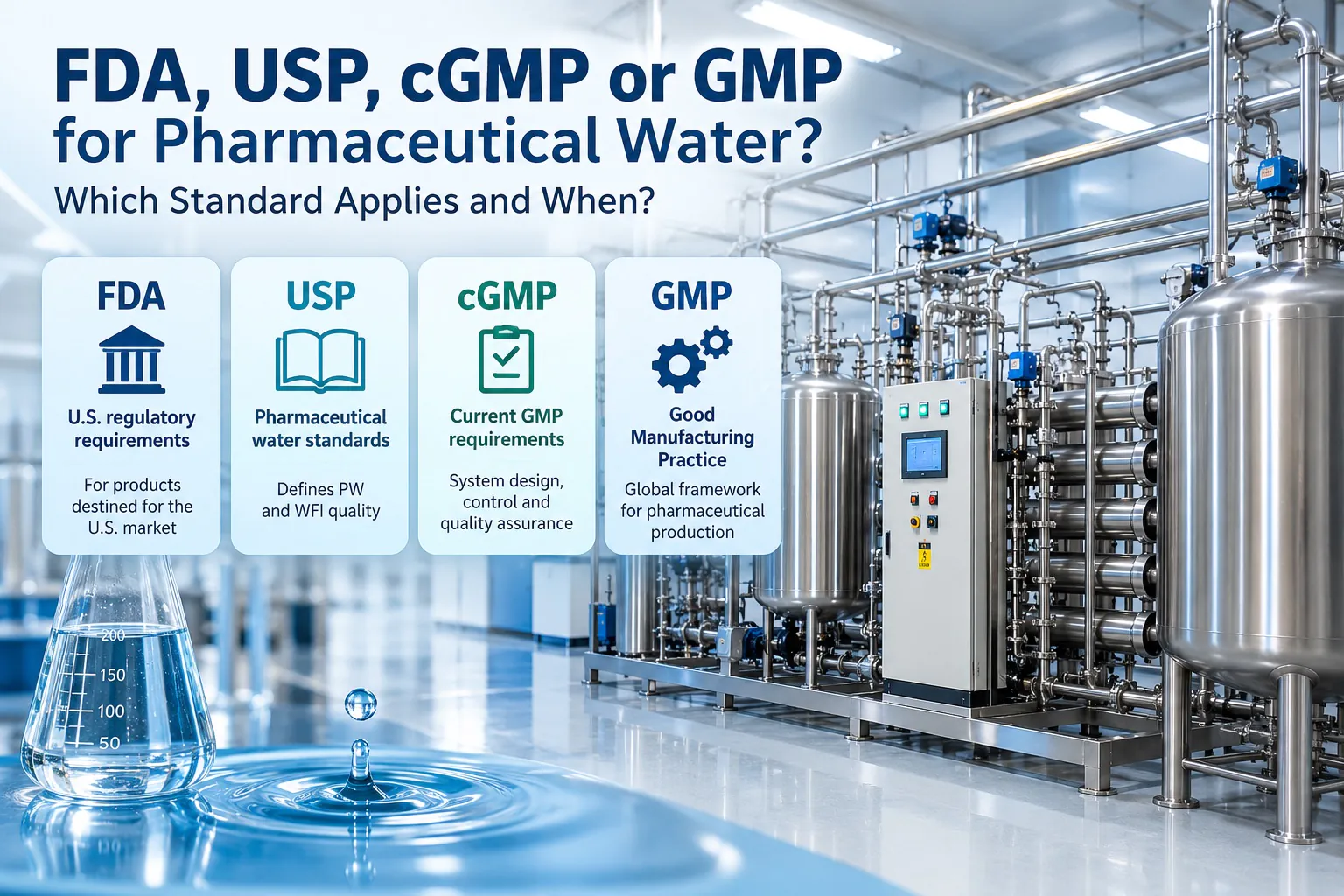
Although these pharmacopoeias share the same objective—ensuring that Purified Water is chemically and microbiologically suitable for pharmaceutical use—there are differences in analytical procedures, regulatory interpretation and implementation.
1. ChP vs USP vs EP: Quick Comparison
The following table provides a practical engineering comparison for pharmaceutical manufacturers operating in multiple regulatory markets.
| Item | Chinese Pharmacopoeia (ChP) | USP | European Pharmacopoeia (Ph. Eur.) |
|---|---|---|---|
| Primary Market | China | United States and international reference | EU / European regulatory markets |
| Water Grade | Purified Water | Purified Water | Water, Purified |
| Typical Use | Preparation, cleaning and processing | Ingredient, processing, testing and pharmaceutical applications | Pharmaceutical preparation and processing |
| Conductivity | According to applicable ChP procedure | USP <645> | Ph. Eur. conductivity procedure |
| TOC / Organic Control | According to current ChP requirements | USP <643> | TOC-based control |
| Microbial Control | GMP system design and monitoring | System-specific monitoring strategy | GMP and water-system monitoring |
| Typical Technology | RO, double-pass RO, RO + EDI | Suitable qualified purification process | Suitable validated purification process |
| Distribution | SS316L sanitary loop commonly applied | Continuous hygienic circulation commonly used | Continuous hygienic circulation commonly used |
| Validation | DQ / IQ / OQ / PQ commonly applied | Lifecycle qualification and validation | EU GMP qualification and validation |
2. Chinese Pharmacopoeia: Engineering Considerations
For manufacturers supplying the Chinese pharmaceutical market, ChP requirements should be incorporated into pharmaceutical facility design and quality-control strategy.
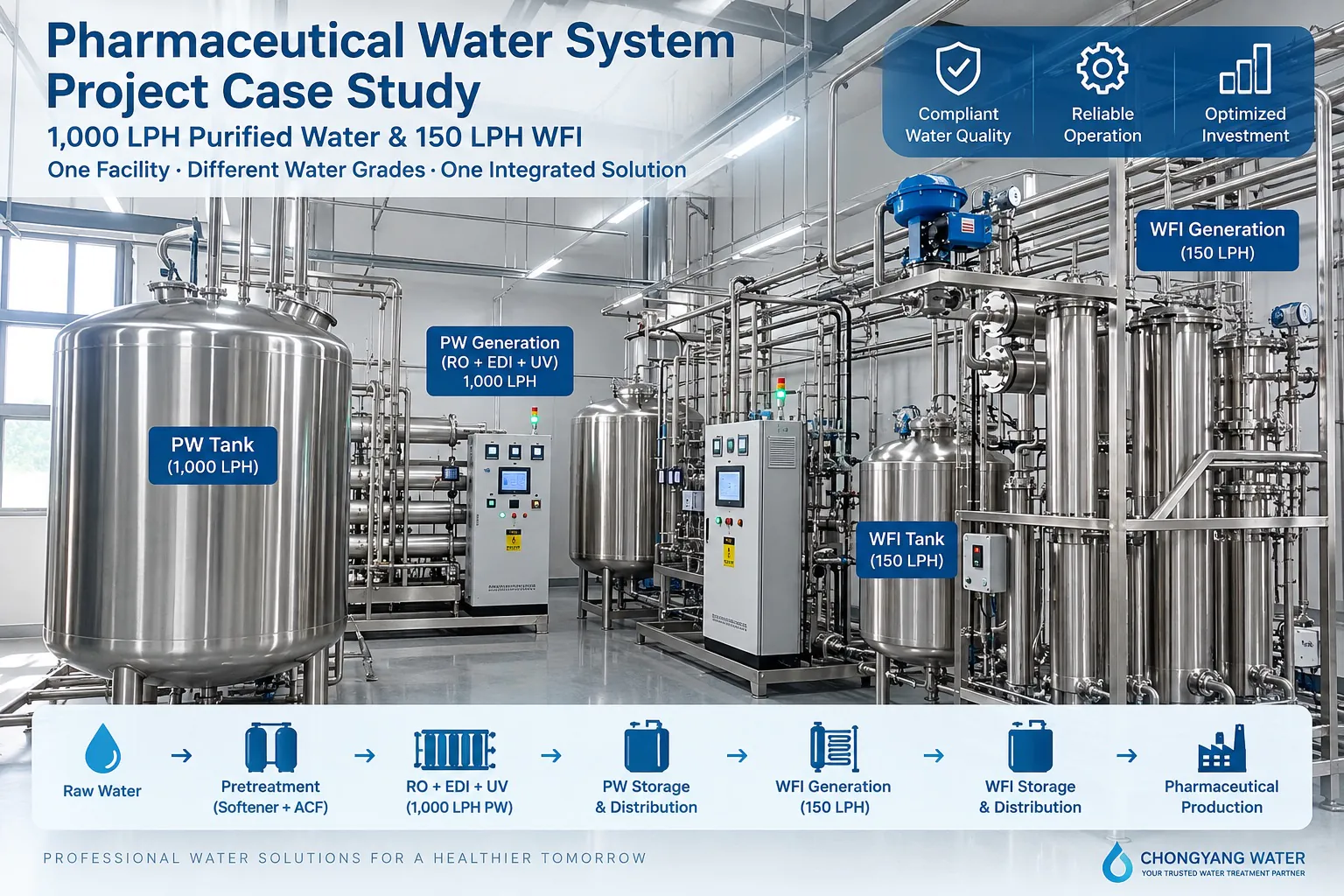
Typical ChP-Oriented Purified Water Process
Pretreatment may include multimedia filtration, activated carbon filtration or alternative dechlorination, water softening, cartridge filtration and chemical dosing where required.
Municipal water containing hardness, residual chlorine, alkalinity and moderate TDS may require softening and dechlorination before RO. Inadequate pretreatment can cause membrane scaling, oxidation damage and unstable permeate quality.
3. USP Purified Water Requirements
USP does not prescribe one mandatory equipment configuration. Instead, the selected purification technology must reliably produce water that complies with applicable requirements.
Typical USP Pharmaceutical Water Configuration
Water Conductivity
USP <645> provides the compendial framework for conductivity testing and ionic purity control.
Total Organic Carbon
USP <643> supports control of organic contamination that conductivity alone cannot adequately indicate.
Typical Online Instrumentation
- Conductivity transmitter
- Temperature sensor
- Flow meter
- Pressure transmitter
- TOC analyzer where required
- Tank level transmitter
4. European Pharmacopoeia Requirements
For European-market pharmaceutical projects, compliance should be considered together with Ph. Eur. monograph requirements, EU GMP expectations, qualification, hygienic system design, microbial control and documentation.
Typical EU GMP Purified Water System
Sanitization Options
5. The Biggest Mistake: Designing Only for Conductivity
A frequent mistake in international pharmaceutical projects is defining the complete system only by an outlet specification such as:
| Design | Configuration | Engineering Assessment |
|---|---|---|
| System A | Single RO → PE Tank → Intermittent Distribution | Lower complexity, but greater stagnation and microbial-control risk |
| System B | Double RO → EDI → SS316L Tank → Continuous Loop | Better ionic, microbial and lifecycle control |
Two systems may achieve similar conductivity at a specific moment, but they do not necessarily provide the same pharmaceutical engineering assurance.
6. How to Design One PW System for China, US and European Markets
For multinational pharmaceutical manufacturers, a more practical strategy is to establish a common engineering design basis capable of satisfying applicable requirements across multiple markets.
Recommended High-Level Process
Key Engineering Specifications
7. Storage and Distribution Are as Important as RO and EDI
Water quality deterioration frequently occurs after the generation skid if storage and distribution systems are poorly designed.
SS316L is widely used for pharmaceutical product-contact water piping.
Reduces stagnation and helps manage microbial proliferation.
Unused branches and stagnant piping should be minimized.
Tank and distribution loop should be included in a defined sanitization strategy.
8. Validation Strategy for International Pharmaceutical Projects
Qualification should begin during engineering rather than after equipment installation.
| Stage | Purpose |
|---|---|
| DQ | Confirms that system design meets the URS and regulatory requirements. |
| FAT | Tests mechanical, electrical, automation and functional requirements before shipment. |
| IQ | Verifies equipment, piping, instruments and installation. |
| OQ | Tests alarms, interlocks, operating ranges and sanitization functions. |
| PQ | Demonstrates consistent production and distribution of qualified water. |
9. Which Standard Should an Export Pharmaceutical Company Follow?
The correct regulatory basis depends on the destination market and product-registration strategy.
Design around applicable ChP and Chinese GMP requirements.
Incorporate applicable USP requirements and FDA expectations.
Consider Ph. Eur. requirements together with EU GMP expectations.
For multinational pharmaceutical plants, the URS should cover the most demanding applicable requirements for water quality, generation technology, materials, sanitization, instrumentation, automation, microbial monitoring, documentation and qualification.
Conclusion
Chinese Pharmacopoeia, USP and European Pharmacopoeia share the same fundamental objective: pharmaceutical Purified Water must remain consistently suitable for its intended use.
The practical differences become important when these standards are translated into an actual pharmaceutical purified water system.
A properly engineered system should not merely pass a water-quality test during commissioning. It should maintain controlled chemical and microbiological quality throughout routine pharmaceutical production.
Need a Pharmaceutical Purified Water System for Global Markets?
We provide complete GMP pharmaceutical water solutions for projects designed around ChP, USP, Ph. Eur. and international pharmaceutical manufacturing requirements, including RO + EDI generation systems, SS316L storage and distribution loops, sanitization systems and DQ/IQ/OQ/PQ validation support.
Contact Our Engineering TeamMore Posts