
Blog
How to Maintain a Multi-Effect Distiller for Reliable WFI Production
A practical maintenance guide for pharmaceutical Multi-Effect Distillers used in Water for Injection (WFI) production.
Introduction
A Multi-Effect Distiller (MED) is one of the most important technologies for producing high-quality Water for Injection (WFI) in pharmaceutical facilities.
By using multiple evaporation effects and energy recovery between stages, MED systems achieve reliable WFI production with excellent thermal efficiency.
However, long-term operation requires proper inspection, cleaning, calibration and preventive maintenance to maintain production capacity, WFI quality and equipment lifetime.
What Is a Multi-Effect Distiller?
A multi-effect distiller is a thermal purification system that produces WFI through repeated evaporation and condensation processes.
A typical pharmaceutical MED system consists of:
- Feed water preheater
- Multiple evaporation chambers
- Heat transfer tubes
- Vapor separators
- Condenser section
- WFI collection system
Multi-Effect Distiller Working Principle
The MED process uses steam energy efficiently by transferring vapor from one effect to the next effect.
Why Is Regular Maintenance Important?
Regular maintenance ensures stable WFI production performance and prevents unexpected shutdowns.
Without proper maintenance, problems such as scaling, heat transfer reduction, instrument deviation and unstable WFI quality may occur.
A preventive maintenance strategy helps pharmaceutical facilities reduce operating costs and extend equipment service life.
1. Maintain Heat Transfer Efficiency
The evaporation efficiency of a multi-effect distiller depends on effective heat transfer between steam and feed water.
During operation, deposits may accumulate on heat transfer surfaces, including:
- Calcium carbonate scale
- Silica deposits
- Metal oxide deposits
2. Prevent Scaling and Maintain Heat Transfer Performance
Scaling is one of the most common problems affecting multi-effect distiller performance.
Deposits on evaporation tubes reduce heat transfer efficiency and may cause:
- Lower WFI production capacity
- Higher steam consumption
- Longer heating time
- More frequent cleaning requirements
3. Protect WFI Quality Stability
A multi-effect distiller must continuously produce WFI that meets pharmaceutical requirements.
Regular maintenance helps prevent:
- Increasing conductivity
- Poor vapor separation
- Unstable distillate quality
- Microbial contamination risks
Common Problems During Multi-Effect Distiller Operation
Long-term operation without proper maintenance may cause efficiency reduction and equipment performance problems.
| Problem | Possible Cause | Maintenance Solution |
|---|---|---|
| Low WFI Output | Scaling inside evaporation chambers | CIP cleaning and inspection |
| High Steam Consumption | Reduced heat transfer efficiency | Remove deposits and check insulation |
| Unstable WFI Quality | Instrument deviation or separator problems | Calibration and component inspection |
| Long Start-up Time | Heat exchanger fouling | Cleaning and performance verification |
Reduced WFI Production Capacity
A decrease in WFI production capacity usually indicates reduced heat transfer performance or abnormal operating conditions.
- Scale accumulation inside evaporation tubes
- Insufficient steam pressure
- Blocked flow passages
- Aging components
Increased Steam Consumption
Higher steam consumption for the same WFI output usually indicates efficiency loss.
- Heat exchanger scaling
- Steam valve problems
- Poor insulation performance
- Incorrect operating parameters
CIP Cleaning Process for Multi-Effect Distillers
Chemical cleaning is used to remove deposits and restore heat transfer performance when scaling occurs.
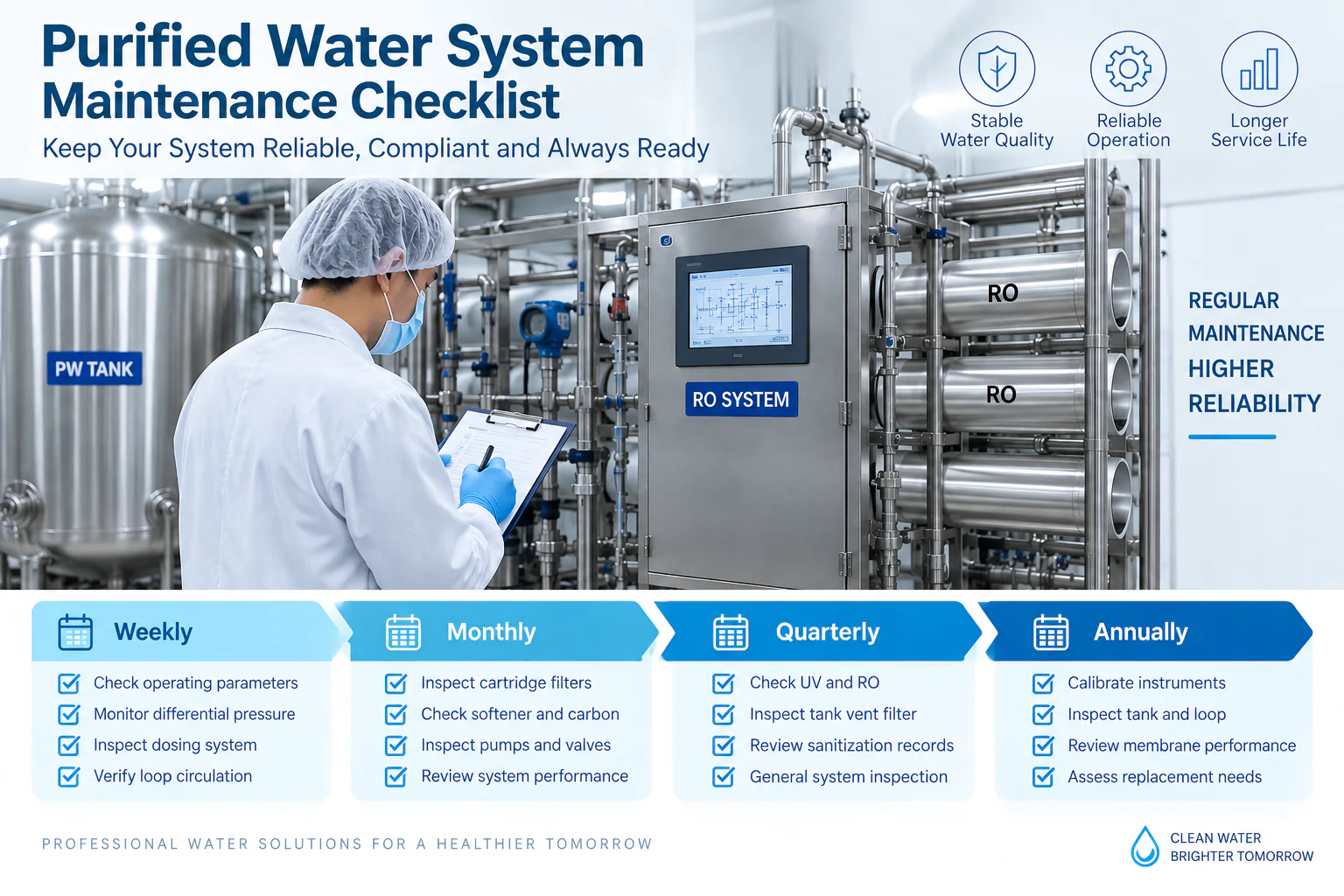
Multi-Effect Distiller Maintenance Schedule
A preventive maintenance schedule helps identify potential problems before they affect WFI production.
| Frequency | Maintenance Items | Purpose |
|---|---|---|
| Daily | Check temperature, pressure, conductivity and alarms | Confirm normal operation |
| Weekly | Inspect valves, pumps, steam traps and leakage points | Prevent equipment failure |
| Monthly | Check instruments and operating parameters | Maintain measurement accuracy |
| Quarterly | Inspect heat transfer performance and scaling condition | Maintain production efficiency |
| Annually | Complete preventive maintenance and system inspection | Extend equipment lifetime |
Key Components Requiring Maintenance
Evaporator Heat Exchanger
Inspect scaling, corrosion and heat transfer efficiency of evaporation tubes.
Condenser System
Check cooling performance, leakage and heat exchange efficiency.
Steam Valves and Components
Inspect steam valves, traps and control components.
Online Instruments
Maintain conductivity sensors, pressure transmitters and temperature sensors.
Instrument Calibration and Control Verification
Accurate instruments are essential for pharmaceutical WFI production and process control.
- Conductivity sensor calibration
- Temperature transmitter verification
- Pressure transmitter calibration
- Flow meter checking
- PLC alarm and control function testing
Preventive Maintenance Checklist
- Monitor operating parameters regularly
- Inspect heat transfer surfaces
- Perform CIP cleaning when required
- Calibrate critical instruments
- Check valves and pumps
- Review WFI quality data
- Maintain spare parts inventory
Frequently Asked Questions
Q1: How often should a multi-effect distiller be cleaned?
A: Cleaning frequency depends on feed water quality, operating conditions and scaling level. Regular inspection helps determine the correct CIP interval.
Q2: What causes reduced WFI production capacity?
A: Common causes include scaling, insufficient steam supply, heat exchanger fouling and abnormal operating conditions.
Q3: How can scaling be prevented?
A: Proper pretreatment, feed water monitoring and regular CIP cleaning help reduce scaling risks.
Q4: What spare parts should be prepared?
A: Common spare parts include seals, gaskets, valve kits, instrument components and pump wear parts.
Conclusion
A multi-effect distiller is a critical system for pharmaceutical WFI production. Reliable performance depends not only on equipment design but also on proper maintenance strategies.
Through preventive maintenance, CIP cleaning, instrument calibration and performance monitoring, pharmaceutical facilities can achieve stable WFI production and longer equipment lifetime.
Why Choose CHONGYANG WATER?
- Professional pharmaceutical water engineering experience
- Customized WFI generation solutions
- Multi-effect distiller design and technical support
- Complete WFI storage and distribution engineering
- International project experience
Need Technical Support for Your Multi-Effect Distiller?
Send us your equipment capacity, current operating data, WFI requirements and maintenance challenges.
CHONGYANG WATER provides professional pharmaceutical water solutions from design, manufacturing to technical support.
Contact Our Engineering TeamMore Posts