
Blog
When Should You Choose Membrane-Based WFI Generation System?
A complete engineering guide explaining when membrane-based WFI systems are suitable compared with traditional thermal WFI technologies.
Introduction
Water for Injection (WFI) is one of the highest-quality water grades required in pharmaceutical manufacturing, where strict control of impurities, microorganisms, and endotoxins is essential.
Traditionally, WFI production has mainly relied on thermal technologies such as Multi-Effect Distillation (MED) and Vapor Compression Distillation.
However, with advances in membrane separation technology, membrane-based WFI generation systems combining double-pass RO, EDI, ultrafiltration, and advanced sanitization technologies have become an increasingly attractive solution.
The selection between membrane WFI and thermal WFI depends on production capacity, available utilities, operating cost, validation requirements, and long-term project objectives.
What Is a Membrane-Based WFI System?
A membrane-based WFI system is a high-purity water generation system that produces WFI-quality water using advanced membrane separation technologies instead of evaporation and condensation.
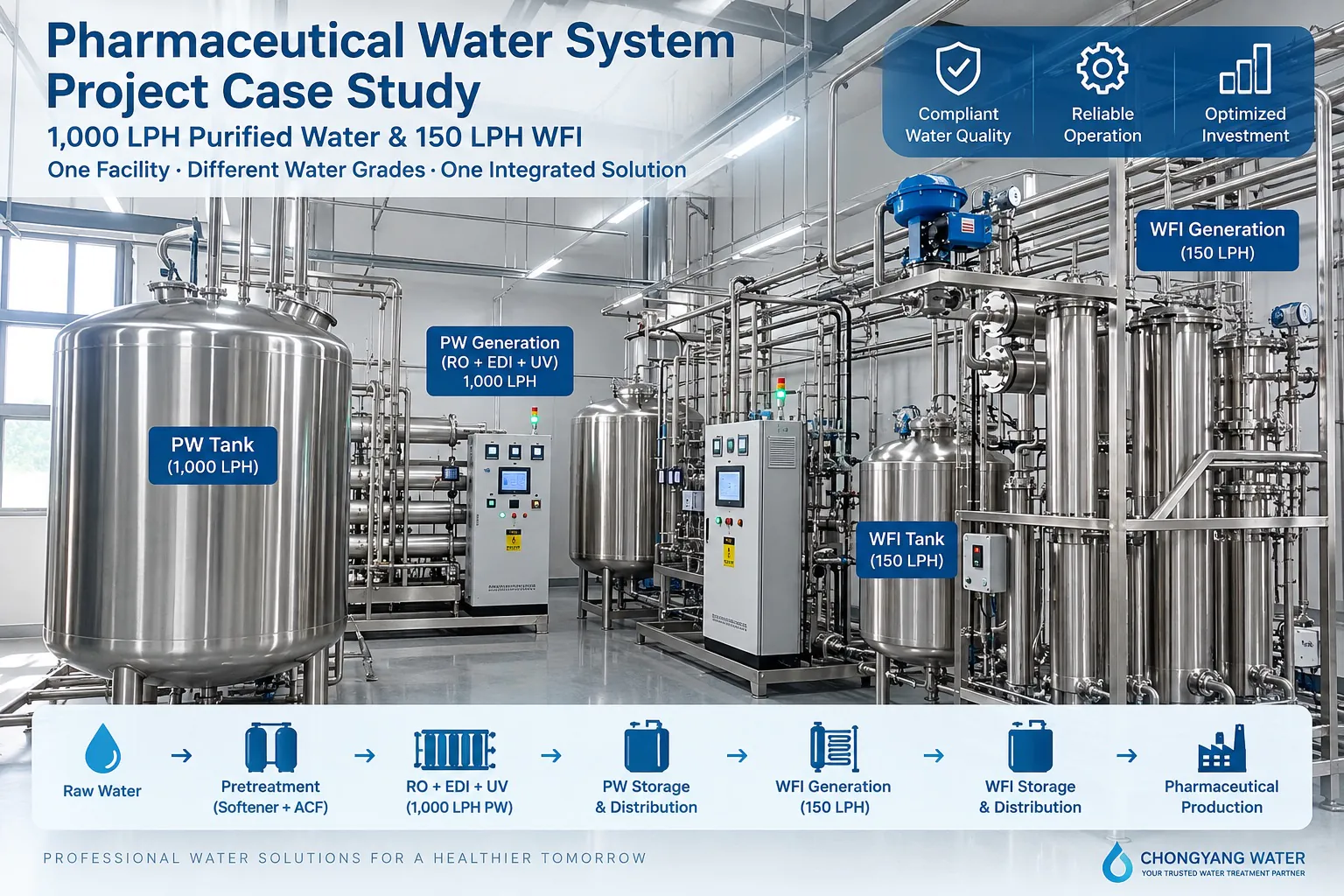
A typical membrane WFI generation process includes:
Main Components of a Membrane WFI System
A complete membrane-based WFI system may include:
- Multimedia Filter
- Activated Carbon Filter (if required)
- Water Softener
- Cartridge Filtration
- Double-Pass RO System
- Electrodeionization (EDI)
- Ultrafiltration Unit
- UV Sterilizer
- TOC Monitoring
- WFI Storage Tank
- Hot Water or Ozone Sanitization Loop
The system removes dissolved salts, organic impurities, microorganisms, endotoxins, and particulate contamination through multiple purification stages.
When Should You Choose a Membrane-Based WFI System?
Membrane-based WFI generation is not suitable for every project. However, it provides significant advantages in specific applications where energy efficiency, flexibility, and compact design are important.
1. When Energy Consumption Needs to Be Reduced
Thermal WFI systems require large amounts of energy for evaporation and steam generation. Membrane-based systems use pressure-driven separation technologies, resulting in lower energy consumption.
| Item | Membrane WFI | Thermal WFI |
|---|---|---|
| Main Technology | RO + EDI + UF | Distillation |
| Main Energy Source | Electricity | Clean Steam / Thermal Energy |
| Boiler Requirement | Normally not required | Usually required |
| Operating Cost | Lower energy consumption | Higher energy demand |
2. When Production Capacity Is Small or Medium
Membrane WFI systems are especially suitable for small and medium pharmaceutical facilities where WFI demand is moderate.
Typical applications include:
- Medical device manufacturing
- Biotechnology laboratories
- Small pharmaceutical plants
- Research and development facilities
- Cosmetic and healthcare production
500 L/h – 3000 L/h
3. When Installation Space Is Limited
Compared with large thermal distillation systems, membrane WFI systems usually have a more compact structure and can be supplied as skid-mounted systems.
- Compact equipment footprint
- Factory assembled skid design
- Reduced installation time
- Flexible layout options
- Suitable for existing buildings
4. When Industrial Steam Is Not Available
Many pharmaceutical facilities do not have existing clean steam or industrial boiler systems. In these cases, membrane-based WFI technology can reduce infrastructure requirements.
- No large steam generation system required
- Lower utility investment
- Simplified installation
- Reduced maintenance complexity
5. When Advanced Automation and Monitoring Are Required
Modern membrane WFI systems can integrate advanced automation and real-time monitoring to support pharmaceutical quality management.
- PLC automatic control
- HMI touchscreen operation
- Conductivity monitoring
- TOC monitoring
- Temperature monitoring
- Data recording and alarm management
Membrane-Based WFI vs Multi-Effect Distillation
Both technologies can produce high-quality pharmaceutical water. The best choice depends on project conditions, utilities, capacity, and operating strategy.
| Item | Membrane-Based WFI | Multi-Effect Distillation |
|---|---|---|
| Technology | RO + EDI + UF + Final Purification | Evaporation and Condensation |
| Energy Source | Electricity | Clean Steam / Thermal Energy |
| Steam Requirement | Normally unnecessary | Required |
| Installation Space | Compact skid design | Larger equipment area |
| Best Application | Small and medium pharmaceutical plants | Large WFI production facilities |
Feed Water Quality Requirements
The performance and reliability of a membrane WFI system strongly depend on feed water quality.
| Parameter | Purpose |
|---|---|
| Conductivity / TDS | Evaluate dissolved ionic content |
| Hardness | Prevent scaling |
| Silica | Protect purification performance |
| TOC | Organic contamination control |
| Microbial Level | Sanitization design requirement |
Sanitization Methods for Membrane WFI Systems
Hot Water Sanitization
Uses elevated temperature circulation to reduce microbial contamination.
Ozone Sanitization
Provides continuous microbial control for storage and distribution loops.
Chemical Sanitization
Used when compatible materials and process requirements allow.
WFI Storage and Distribution System
The WFI generation unit must work together with a properly designed storage and distribution loop to maintain water quality.
Frequently Asked Questions
Q1: Can membrane technology produce WFI-quality water?
A:
Yes. With proper design including RO, EDI, UF, final purification, and validated sanitization, membrane systems can achieve pharmaceutical-grade water quality.
Q2: Is membrane WFI cheaper than distillation?
A:
In many applications, membrane WFI provides lower energy consumption and reduced utility requirements.
Q3: Does membrane WFI require a distribution loop?
A:
Yes. Proper storage and sanitary circulation are essential for maintaining WFI quality.
Why Choose CHONGYANG WATER?
- Professional pharmaceutical water engineering experience
- Customized membrane-based WFI solutions
- RO + EDI + UF integrated purification technology
- WFI storage and distribution engineering
- CIP/SIP and sanitization solutions
- International pharmaceutical project support
Need a Customized WFI Water System?
Send us:
✓ Required WFI Capacity
✓ Feed Water Quality
✓ Pharmaceutical Standard
✓ Utility Conditions
✓ Storage & Distribution Requirements
CHONGYANG WATER provides complete pharmaceutical water solutions from process design to commissioning.
Contact Our Engineering TeamMore Posts