
Blog
What Feed Water Is Best for a Water for Injection System?
Introduction
The performance of a Water for Injection (WFI) system depends not only on the WFI generator itself, but also on the quality of the water entering it.
In many pharmaceutical projects, considerable attention is paid to the multi-effect distiller, vapor compression still, or membrane-based WFI unit, while the feed water quality receives much less attention. This can lead to scaling, unstable conductivity, shortened equipment life, frequent cleaning, reduced evaporation efficiency, microbiological problems, and inconsistent WFI production.
For this reason, one of the most important engineering questions during WFI system design is:
In most pharmaceutical applications, Purified Water (PW) is the preferred feed water for WFI generation rather than untreated municipal water, softened water, or ordinary single-pass RO water with unstable quality.
The exact configuration, however, depends on the feed-water chemistry, WFI production technology, required capacity, local utilities, and applicable pharmaceutical standards.
Why Feed Water Quality Matters in a WFI System
A WFI generator separates purified water from dissolved salts, microorganisms, endotoxins, and other contaminants through distillation or another validated purification process.
But this does not mean that any type of source water can be introduced directly into the system.
Poor feed water places unnecessary load on the WFI equipment.
For example, high calcium, magnesium, silica, chloride, or total dissolved solids can cause:
- Scale formation
- Heat-transfer loss
- Higher steam consumption
- Conductivity fluctuations
- Frequent chemical cleaning
- Corrosion risk
- Shorter equipment service life
- Reduced WFI production capacity
Microbiologically unstable feed water can also increase the contamination burden entering the system.
Which Type of Feed Water Is Best for WFI Generation?
There are several possible feed-water sources, but they are not equally suitable.
1. Raw Water or Municipal Water
Direct municipal or groundwater supply is generally not recommended as feed water for a pharmaceutical WFI generator.
Raw water may contain:
- Calcium and magnesium hardness
- Silica
- Chloride
- Suspended solids
- Iron and manganese
- Organic matter
- Microorganisms
- Disinfectant residuals
- Variable conductivity
If this water enters a multi-effect distiller directly, minerals may concentrate on heating surfaces.
For example, calcium carbonate and other salts can form deposits inside the first-effect evaporator.
As scaling develops, heat transfer efficiency decreases.
The WFI generator then requires:
- More steam
- Higher operating temperature
- More frequent cleaning
- Longer maintenance downtime
This is why untreated water should normally be purified before entering the WFI system.
2. Softened Water
Softened water is better than untreated hard water, but it is still usually insufficient as the final feed water for pharmaceutical WFI generation.
A water softener removes mainly calcium and magnesium by ion exchange.
This helps reduce hardness-related scale, but it does not effectively remove:
- Sodium
- Chloride
- Silica
- Nitrate
- Organic contaminants
- Most dissolved salts
- Microbial contamination
In addition, the conductivity of softened water may remain relatively high.
Therefore, softening should normally be considered a pre-treatment stage before RO, rather than the final treatment before a WFI generator.
3. Single-Pass RO Water
Reverse osmosis significantly reduces dissolved salts, hardness, organics, and microorganisms.
Single-pass RO water can therefore be a much better feed source than raw or softened water.
However, its suitability depends strongly on the source-water quality and the stability of the RO system.
If feed-water conductivity fluctuates, the RO permeate conductivity may also vary.
Under favorable conditions, this may be acceptable for some equipment designs, but it may not provide the most stable long-term feed condition for pharmaceutical WFI generation.
The system must also consider:
- RO rejection performance
- Membrane age
- Feed temperature
- Recovery rate
- Scaling tendency
- Microbiological control
For higher-grade pharmaceutical applications, further purification is usually preferred.
4. Double-Pass RO Water
Double-pass reverse osmosis provides more stable water quality and significantly reduces the ionic load entering the WFI generator.
Compared with single-pass RO, double-pass RO can provide:
- Lower conductivity
- Lower hardness
- Lower chloride
- Lower silica
- More stable feed water
- Reduced scaling risk
This can substantially improve the operating condition of a multi-effect distiller.
5. RO + EDI Purified Water
For many modern pharmaceutical plants, RO + EDI purified water is an excellent feed source for WFI generation.
A typical pharmaceutical purified water system may use:
EDI continuously removes residual ions from RO permeate without conventional acid-and-alkali regeneration.
The resulting purified water can typically provide very low conductivity and stable quality.
For the WFI generator, this means:
- Lower mineral loading
- Reduced evaporator scaling
- More stable heat transfer
- Lower cleaning frequency
- Reduced contamination burden
- More predictable operating performance
How Feed Water Quality Affects WFI Equipment
1. Scale Formation
Scaling is one of the most common consequences of poor feed water.
When water is heated inside a multi-effect distiller, dissolved salts become increasingly concentrated.
Calcium, magnesium, carbonate, sulfate, and silica may deposit on heat-transfer surfaces.
A heavily scaled evaporator may also lose production capacity.
The equipment may require acid cleaning or other maintenance procedures more frequently.
Using low-hardness, low-conductivity purified water significantly reduces this risk.
2. Conductivity Instability
Conductivity is an important operating parameter in pharmaceutical water systems.
If the WFI feed water conductivity changes significantly, the operating conditions of the WFI generator also change.
For example, seasonal variations in municipal water may increase:
- TDS
- Chloride
- Sodium
- Silica
Although the WFI generator is designed to separate non-volatile impurities, stable feed water reduces process fluctuations and makes system operation easier to control and validate.
3. Corrosion Risk
High chloride concentration can be particularly undesirable in stainless-steel systems.
Pharmaceutical WFI equipment is typically constructed using high-grade stainless steel such as SS316L for product-contact components.
However, improper water chemistry combined with elevated temperature can increase corrosion risk.
Good-quality purified water reduces aggressive ionic contaminants and helps protect:
- Evaporators
- Heat exchangers
- Piping
- Valves
- Storage tanks
Proper material selection, welding, passivation, and surface finish remain equally important.
4. Microbiological Loading
Poor feed-water systems can develop microbial contamination in:
- Storage tanks
- RO permeate tanks
- Low-flow piping
- Dead legs
- Filters
Although distillation provides an effective microbial and endotoxin barrier when correctly designed and operated, high microbiological loading upstream is still poor engineering practice.
The complete water system should therefore minimize microbial growth through:
- Continuous circulation
- Hygienic piping design
- Proper tank vent filtration
- Hot water sanitization
- Ozone sanitization where appropriate
- Controlled dead-leg design
5. Higher Maintenance Cost
Poor-quality feed water often results in:
- More frequent descaling
- Higher chemical consumption
- More downtime
- More frequent gasket inspection
- More cleaning validation work
- Reduced equipment availability
Therefore, investing in better purified water treatment upstream can reduce the total lifecycle cost of the WFI system.
How Feed Water Quality Affects Final WFI Quality
The WFI generator is the final purification barrier, but stable feed water still contributes significantly to reliable WFI production.
Poor feed water can indirectly affect final WFI quality by creating unstable operating conditions.
Potential issues include:
- Conductivity excursions
- Carryover risk under abnormal operating conditions
- Reduced separation efficiency
- Increased equipment fouling
- Microbial burden upstream
- More frequent shutdown and restart cycles
For pharmaceutical production, WFI quality must remain consistent during normal operation, not only during initial equipment testing.
Typical WFI quality control may include monitoring of:
- Conductivity
- TOC
- Microbiological quality
- Endotoxins
- Temperature
- Flow
- Storage and distribution conditions
Recommended WFI Feed Water System Configuration
For a typical pharmaceutical project, a robust configuration may be:
The exact process should be selected according to the actual raw-water analysis.
For example, high-hardness groundwater may require stronger softening, while high-silica water may require careful RO recovery control.
High-organic-content source water may require additional pretreatment.
| Feed Water Parameter | Why It Matters |
|---|---|
| Conductivity / TDS | Indicates dissolved ionic loading |
| Hardness | Major scaling risk |
| Silica | Can create difficult-to-remove deposits |
| Chloride | Relevant to corrosion risk |
| Iron / Manganese | Can foul membranes and equipment |
| TOC | Indicates organic contamination |
| Microbiology | Affects microbial control strategy |
| Temperature | Influences RO and WFI operation |
| pH | Affects scaling and corrosion behavior |
On mobile devices, swipe horizontally to view the complete engineering table.
FAQ
Can tap water be supplied directly to a WFI generator?
It is generally not recommended. Municipal water can contain hardness, salts, chlorine, microorganisms, and variable conductivity that may increase scaling, corrosion, and maintenance requirements.
Is softened water enough for a multi-effect distiller?
Usually not as the preferred pharmaceutical design. Softening removes mainly calcium and magnesium but leaves many other dissolved ions. RO or RO + EDI purified water normally provides a more stable feed source.
Is RO water suitable as feed water for a WFI system?
Yes, properly designed RO water can be suitable. However, double-pass RO or RO + EDI generally provides more stable conductivity and lower scaling potential than single-pass RO.
Why is low conductivity important for WFI feed water?
Lower conductivity generally indicates a lower concentration of ionic impurities. This reduces mineral accumulation and the operating load on the WFI generator.
Can poor feed water cause bacterial problems in WFI production?
Poor upstream microbial control can increase the microbiological burden of the overall water system. Good hygienic design, continuous circulation, sanitization, and proper purified water storage are therefore important.
What is the best feed water for a multi-effect distiller?
For many pharmaceutical projects, stable Purified Water produced by double-pass RO or RO + EDI is the preferred engineering solution.
Is a water analysis required before selecting the WFI feed-water system?
Yes. Raw-water conductivity, hardness, silica, chloride, TOC, microbiological condition, and other parameters should be evaluated before the pretreatment and purified water system are finalized.
Conclusion
The performance of a pharmaceutical Water for Injection system begins with the quality of its feed water.
Using untreated raw water or only softened water may increase scaling, conductivity variation, corrosion risk, microbial burden, steam consumption, and maintenance frequency.
For many pharmaceutical applications, the preferred engineering approach is:
This configuration provides a stable, low-conductivity feed source that helps protect the WFI generator and supports consistent pharmaceutical water quality.
However, the optimal design should always be based on actual raw-water analysis, WFI capacity, production schedule, utility availability, and required pharmaceutical standards.
Need Help Selecting the Right Feed Water System for Your WFI Plant?
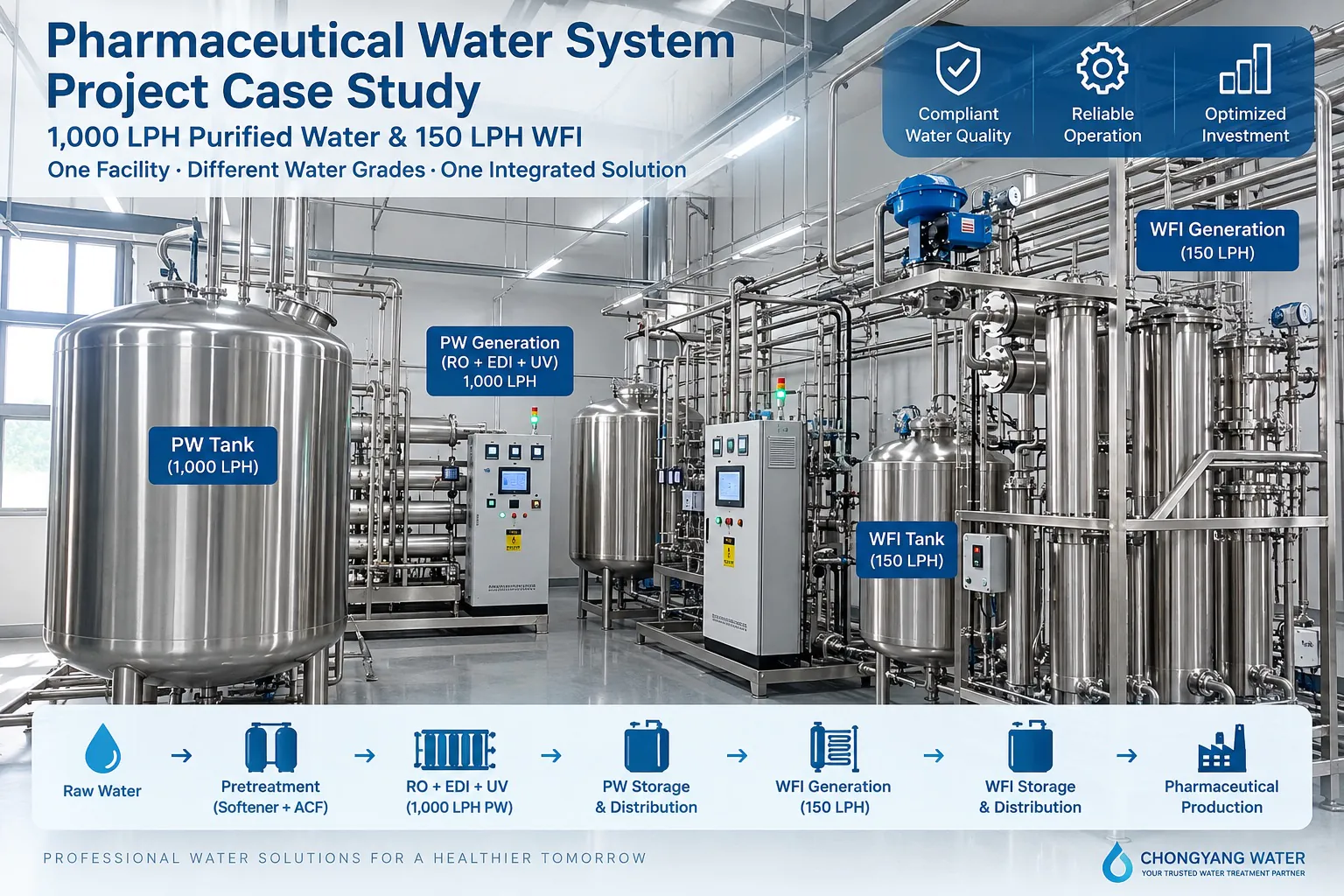
We design and manufacture integrated pharmaceutical purified water and Water for Injection systems, including pre-treatment, double-pass RO, EDI, multi-effect distillation, WFI storage, and sanitary distribution loops.
Send us your raw-water analysis, required WFI capacity, daily consumption, operating hours, and pharmaceutical water requirements, and our engineering team can recommend a suitable PW + WFI system configuration.
Request a WFI System Proposal →More Posts