
Blog
Purified Water System Preventive Maintenance Checklist: What to Do Weekly, Monthly, and Annually
Introduction
A pharmaceutical Purified Water (PW) system is designed to continuously produce, store, and distribute water that meets defined quality requirements. However, achieving the required water quality during commissioning does not guarantee that the system will continue to perform reliably throughout its service life.
Membrane fouling, mineral scaling, exhausted activated carbon, contaminated vent filters, inaccurate instruments, worn pump seals, and poorly controlled sanitization can gradually affect system performance. These problems may first appear as increasing differential pressure, declining RO permeate flow, unstable conductivity, higher microbial counts, or more frequent alarms.
For this reason, purified water system preventive maintenance should be based on both a planned maintenance schedule and actual operating trends.
The exact configuration varies by project, but the maintenance principle remains the same: protect the purification equipment, control microbial growth, maintain hygienic conditions, and verify that critical instruments continue to provide reliable measurements.
1. Why Preventive Maintenance Matters
Maintenance of a pharmaceutical water system is not simply about preventing mechanical failure.
A pump can still run while delivering insufficient flow. An RO membrane can continue producing water while salt rejection gradually deteriorates. A conductivity sensor can display a value even when calibration has drifted. A storage tank can remain mechanically sound while microbial contamination develops inside the system.
Therefore, maintenance should focus on four areas:
- Water quality: conductivity, TOC where applicable, and microbiological performance.
- Hydraulic performance: flow, pressure, differential pressure, and loop velocity.
- Hygienic condition: sanitization, drainability, vent filtration, and contamination control.
- Equipment condition: membranes, pumps, valves, instruments, filters, seals, and control systems.
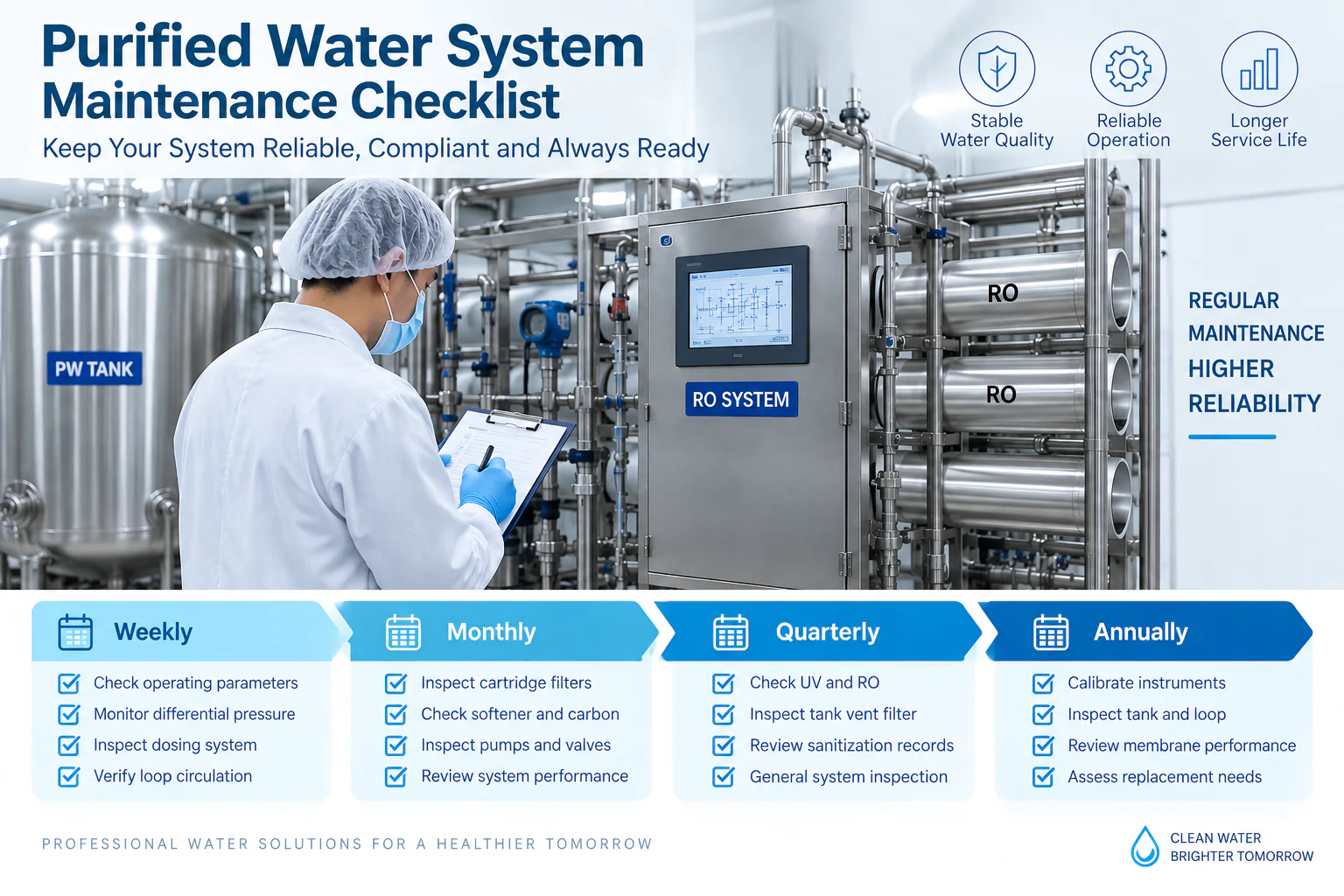
2. Weekly Purified Water System Maintenance Checklist
Weekly inspection should focus primarily on operating trends and early warning signs.
Check RO Operating Parameters
Record and compare:
- RO feed pressure
- Concentrate pressure
- Permeate pressure
- Feed and permeate conductivity
- Feed, permeate, and concentrate flow
- Water temperature
- RO recovery rate
Do not evaluate RO performance only from instantaneous permeate conductivity. Changes in feed-water temperature can also affect membrane production. Trending normalized operating data makes it easier to distinguish normal variation from membrane fouling or scaling.
Check Differential Pressure
Monitor differential pressure across:
- Multimedia filters
- Activated carbon filters
- Cartridge filters
- RO membrane stages
- Other installed filtration units
A gradual increase in differential pressure may indicate accumulated solids, biological fouling, or membrane blockage.
Inspect Chemical Dosing Systems
Where antiscalant, NaOH, acid, sodium bisulfite, or other chemicals are used, check:
- Chemical tank level
- Dosing pump operation
- Tubing and fittings
- Injection points
- Leakage
- Actual dosing rate
Check the PW Distribution Loop
- Circulation pump operation
- Supply and return flow
- Loop pressure
- Return temperature where applicable
- Tank level
- Abnormal vibration or noise
- Visible leakage
Continuous circulation is particularly important in ambient-temperature PW systems because stagnant sections can increase microbiological risk.
3. Monthly Purified Water System Maintenance Checklist
Monthly maintenance should go beyond visual inspection and examine the condition of individual treatment stages.
Inspect Cartridge Filters
Check differential pressure and physical condition. Cartridge filters should generally be replaced according to validated operating limits and actual pressure-drop trends, rather than simply because one month has passed.
Frequent cartridge-filter blockage may indicate ineffective multimedia filtration, activated carbon fines, corrosion, or abnormal raw-water solids.
Check the Water Softener
- Outlet hardness
- Brine concentration
- Salt level
- Regeneration sequence
- Control valve operation
- Regeneration frequency
Hardness leakage can cause calcium and magnesium scaling on RO membranes. If RO differential pressure increases or permeate flow declines while hardness is detected downstream of the softener, investigate the softening stage before simply cleaning the RO.
Inspect Activated Carbon Performance
- Chlorine downstream of the carbon filter
- Differential pressure
- Backwash operation
- Sanitization status
- Microbiological trend where applicable
Activated carbon requires particular attention because its large surface area can support microbial growth when the system is poorly maintained.
Check Pumps, Valves, and Mechanical Components
Inspect pump seals, bearings, couplings, valve actuators, pneumatic tubing, sanitary diaphragm valves, and drain valves. Small leaks should not be ignored in hygienic systems.
4. When Should RO Membranes Be Cleaned?
One of the most common maintenance mistakes is performing RO membrane cleaning according to the calendar alone. Cleaning frequency depends heavily on feed-water quality, pretreatment performance, recovery, membrane loading, and operating conditions.
Indicators can include:
- Reduced normalized permeate flow
- Increased normalized differential pressure
- Reduced normalized salt rejection
- Increasing permeate conductivity
The cleaning chemistry must match the type of contamination. Mineral scale and organic or biological fouling may require different cleaning strategies.
5. Quarterly and Semi-Annual Maintenance
Inspect the PW Tank Vent Filter
A pharmaceutical PW storage tank normally uses a hydrophobic sanitary vent filter, commonly around 0.2 µm, to allow air movement while protecting the tank from airborne contamination.
- Filter integrity
- Housing condition
- Condensation
- Heating function if a heated vent filter is installed
- Replacement history
The replacement interval should follow the validated maintenance program and filter manufacturer's recommendations.
Inspect UV Equipment
Check lamp operating hours, alarm status, UV intensity where monitored, quartz sleeve condition, and electrical components. UV performance decreases as lamps age or sleeves become fouled.
Inspect EDI Performance
For an RO + EDI purified water system, trend:
- EDI feed conductivity
- Product conductivity / resistivity
- Product and concentrate flow
- Voltage and current
- Operating pressure
6. Hot-Water or Pasteurization Sanitization
For systems designed for thermal sanitization, hot-water sanitization is an important microbial-control measure.
During each cycle, verify and record:
- Heating temperature
- Return temperature
- Sanitization holding time
- Circulation flow
- Temperature at critical locations
- Cooling sequence
- Alarm status
A nominal heater setpoint alone does not prove that the entire system has been adequately sanitized. Actual temperature and holding time should follow the site's validated sanitization procedure.
7. Annual Purified Water System Maintenance Checklist
Annual maintenance should provide a more comprehensive review of system condition and performance.
Instrument Calibration
| Instrument | Why It Matters |
|---|---|
| Conductivity / Resistivity | Confirms ionic water quality |
| TOC Analyzer | Monitors organic contamination where installed |
| Temperature Sensor | Supports process and sanitization control |
| Flowmeter | Confirms production and circulation flow |
| Pressure Transmitter | Monitors pumps, filters, and membranes |
| Level Transmitter | Controls tank filling and protects pumps |
| ORP / pH Sensor | Used where required by process design |
Calibration frequency should follow the site's quality system, criticality assessment, manufacturer recommendations, and qualification strategy.
Inspect the Storage and Distribution System
Inspect the hygienic loop for:
- Dead-leg risks and poor drainage
- Leakage and damaged insulation
- Valve and sanitary clamp condition
- Pump seals
- Spray device condition
- Tank internal condition where inspection is permitted
Review RO and EDI Performance Trends
Compare current values with commissioning or validated baseline data for:
- RO normalized permeate flow
- Salt rejection
- Differential pressure
- EDI product quality and operating current
- Chemical consumption
- CIP frequency
8. Practical Preventive Maintenance Schedule
| Frequency | Recommended Maintenance Tasks |
|---|---|
| Daily / Routine | Check conductivity, flow, pressure, tank level, alarms, RO production and loop operation. |
| Weekly | Review RO trends, differential pressure, chemical dosing, leaks, pump operation and PW circulation. |
| Monthly | Inspect cartridge filters, softener, activated carbon, valves, pumps and dosing systems. |
| Quarterly | Review UV condition, vent filter condition, EDI trends and sanitization records. |
| Semi-Annual | Inspect critical hygienic components and review preventive maintenance history. |
| Annual | Calibrate critical instruments, inspect tank and loop condition, review RO/EDI performance, and reassess consumable replacement requirements. |
| Condition-Based | RO CIP, membrane replacement, filter replacement, and corrective sanitization. |
9. Maintenance Records Are as Important as Maintenance Work
A well-maintained pharmaceutical purified water system should have traceable records. Useful records include:
- Operating logs
- Conductivity trends
- Microbiological monitoring results
- TOC trends where applicable
- RO normalized performance
- Filter replacement records
- Membrane CIP records
- Sanitization records
- Instrument calibration certificates
- Preventive maintenance reports
- Alarm and deviation history
- Spare-parts replacement records
These records make it possible to move from reactive maintenance to condition-based preventive maintenance. If cartridge filters previously lasted three months but now reach the same differential pressure in three weeks, simply replacing them more frequently does not address the root cause. The upstream process should be investigated.
FAQ
How often should RO membranes be cleaned?
There is no single cleaning interval suitable for every RO system. CIP should primarily be triggered by normalized performance deterioration, such as declining permeate flow, increasing differential pressure, or declining salt rejection.
How often should a purified water tank vent filter be replaced?
The interval depends on filter type, operating conditions, sterilization exposure, integrity-testing strategy, manufacturer recommendations, and the site's validated maintenance procedure.
How often should a pharmaceutical PW system be sanitized?
Sanitization frequency should be established from system design, microbiological trending, operating pattern, and validation data.
Is hot-water sanitization the same as CIP?
No. CIP (Clean-in-Place) primarily removes process residues, deposits, and fouling. Thermal sanitization primarily controls microorganisms using elevated temperature.
Should conductivity sensors be calibrated every year?
Annual calibration is common, but the correct frequency should be based on instrument criticality, manufacturer recommendations, historical calibration performance, and site quality procedures.
When should RO membranes be replaced?
RO membranes should be evaluated according to normalized flow, salt rejection, pressure drop, cleaning recovery, physical condition, and overall system economics rather than age alone.
Conclusion
Reliable pharmaceutical water quality depends on much more than the original design of the purification equipment. A successful purified water system maintenance program combines routine inspection, operating-data trending, membrane management, sanitization, hygienic maintenance, instrument calibration, and documented preventive maintenance.
Weekly checks help identify abnormal pressure, flow, conductivity, and dosing conditions early. Monthly inspections focus more closely on pretreatment, filters, pumps, valves, and mechanical components. Periodic sanitization and vent-filter management help control microbiological risks, while annual calibration and system review verify that critical measurements and equipment remain reliable.
Most importantly, maintenance intervals should not be treated as isolated calendar dates. RO cleaning, filter replacement, sanitization, and membrane replacement should combine scheduled preventive maintenance with actual system-performance trends.
Need a Maintenance-Friendly Purified Water System?
CHONGYANG WATER provides customized RO, double-pass RO, RO + EDI, pharmaceutical Purified Water generation, PW storage and distribution, hot-water sanitization, CIP, instrumentation, and automated control systems.
For a new project or system upgrade, send us your feed-water analysis, required PW capacity, operating hours, required water quality, storage volume, distribution-loop information, sanitization method, and automation requirements. Our engineering team can configure the treatment process and maintenance strategy around your actual operating conditions.
Request a Purified Water System Proposal →More Posts