
Blog
Engineering Case Study: 1,000 LPH Purified Water and 150 LPH WFI System in One Pharmaceutical Facility
Introduction
A pharmaceutical facility rarely requires only one grade of process water. Different production areas, cleaning operations, formulation processes, and critical applications may require different water qualities. Designing every point of use around the highest water grade is usually unnecessary, while treating each water system as an isolated package can create inefficient equipment selection and poor integration.
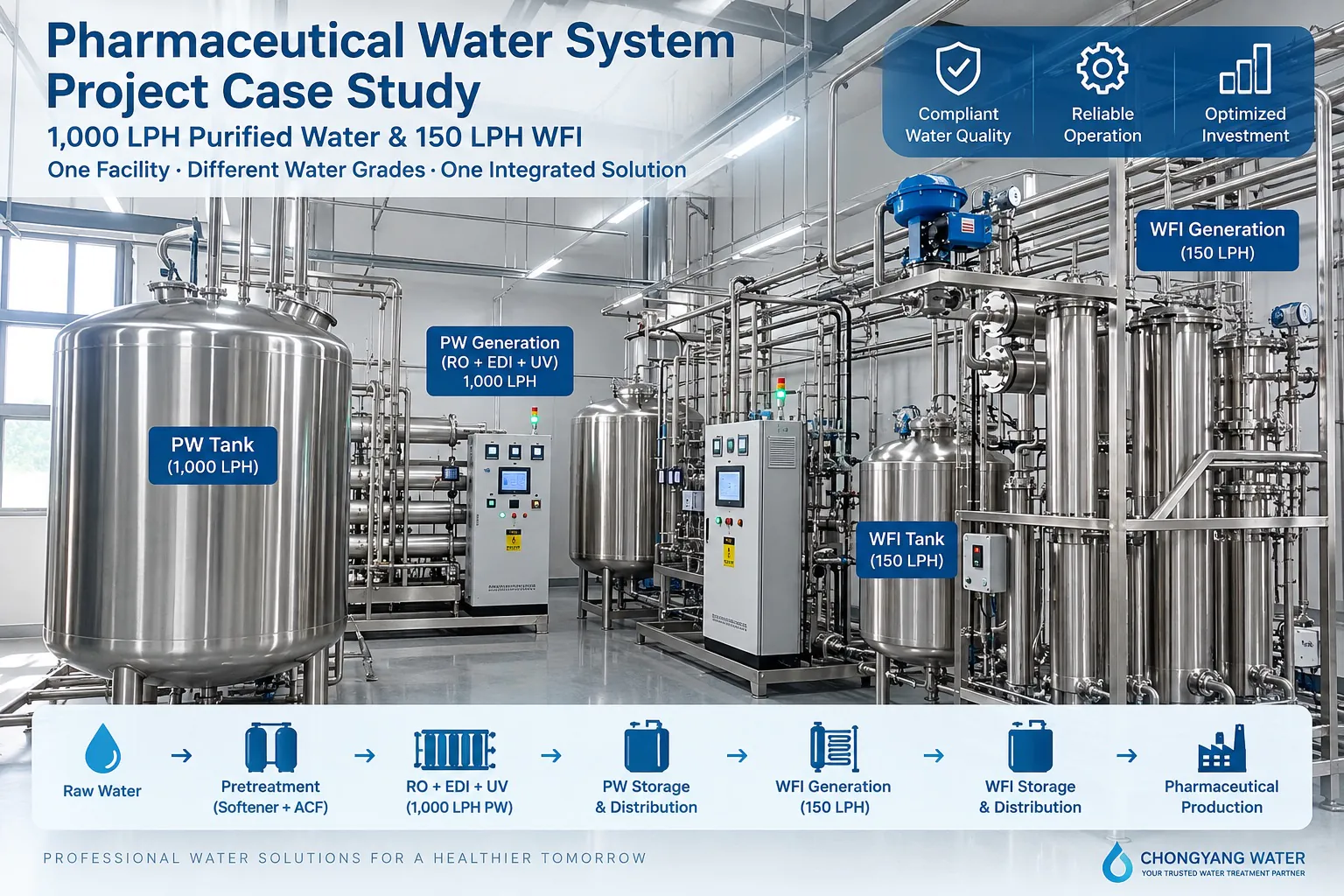
A practical example is a pharmaceutical facility equipped with a 1,000 LPH Purified Water (PW) system and a 150 LPH Water for Injection (WFI) system.
In this configuration, Purified Water has two responsibilities. It serves PW users throughout the facility and also provides the feed water for WFI generation. The WFI system then provides a higher-grade water supply for applications requiring Water for Injection.
1. Project Overview
For this pharmaceutical project, the water system was divided into two main capacities:
| System | Capacity | Main Function |
|---|---|---|
| Purified Water System | 1,000 LPH | Produces PW for pharmaceutical users and supplies feed water to the WFI system |
| Water for Injection System | 150 LPH | Produces WFI for higher-criticality pharmaceutical applications |
The capacity difference is intentional. A pharmaceutical plant may consume considerably more Purified Water than WFI. PW can be required for equipment cleaning, preparation processes, washing, laboratory applications, and other qualified uses, depending on the product and facility.
Therefore, specifying 1,000 LPH PW + 150 LPH WFI allows each generation system to be sized according to its actual duty instead of unnecessarily producing all pharmaceutical water as WFI.
2. From Raw Water to Purified Water
The first stage is the Purified Water generation system. A typical process configuration can be engineered as:
The exact configuration depends on the incoming water analysis, required pharmacopoeial quality, microbial-control strategy, operating hours, and site utilities.
Pretreatment
Pretreatment protects the downstream RO and polishing equipment. Depending on raw-water conditions, it may include:
- Multimedia filtration
- Activated carbon filtration
- Water softening
- Antiscalant dosing
- pH adjustment
- Cartridge filtration
Hardness must be controlled because calcium and magnesium can contribute to RO membrane scaling. Free chlorine must also be properly managed when chlorine-sensitive RO membranes are used.
Reverse Osmosis and Final Polishing
RO removes a large proportion of dissolved ions, organics, colloids, and other contaminants. Where higher ionic purity and stable PW quality are required, the system may incorporate double-pass RO or RO + EDI.
3. One PW System, Two Responsibilities
The most interesting engineering feature of this project is the role of the 1,000 LPH Purified Water system. The generated PW has two destinations.
The PW system is therefore not only a standalone utility supplying Purified Water users. It also becomes an upstream utility for the WFI generation system.
4. Why Use Purified Water as Feed Water for the WFI System?
Feed-water quality has a direct effect on WFI equipment. Whether the WFI is generated through a thermal system such as a multi-effect distiller or through an appropriately designed membrane-based process, upstream water quality remains important.
Scaling
Hardness and other scale-forming constituents can deposit on heat-transfer surfaces. In thermal WFI equipment, scaling can reduce heat-transfer efficiency and increase cleaning requirements.
Conductivity Variation
Large variations in ionic loading can affect downstream process stability. Controlled PW provides a more consistent inlet condition for WFI generation.
Organic & Microbial Load
A properly designed PW system substantially reduces contaminants before WFI generation, while storage, recirculation, sanitization and hygienic piping remain essential.
5. From 1,000 LPH PW to 150 LPH WFI
Only part of the total PW production capacity needs to supply the WFI generator. The complete process relationship can be represented as:
The actual PW consumption of a 150 LPH WFI generator should not simply be assumed to equal 150 LPH. Feed requirement depends on the selected WFI technology, recovery or thermal operating principle, equipment design, and operating conditions. This must be considered when calculating total PW production capacity and simultaneous demand.
6. PW and WFI Are Not Interchangeable Utilities
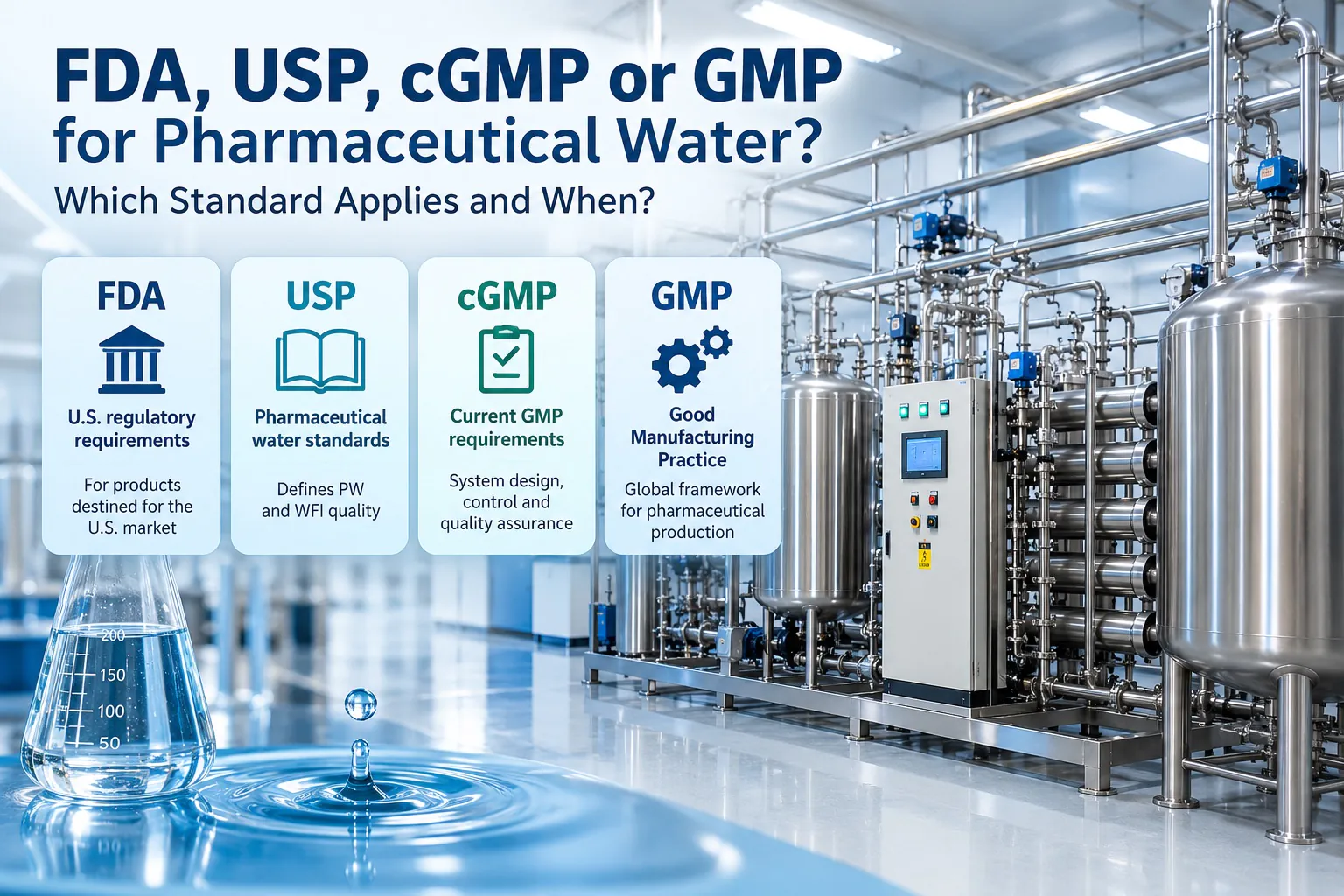
Although both are pharmaceutical water grades, Purified Water and Water for Injection should not be treated as the same utility.
The appropriate water grade at each point of use is determined by the manufacturing process, product requirements, applicable pharmacopoeia, GMP strategy, and the user's validated procedures.
7. Storage and Distribution Are Part of the Water System
Generating compliant water is only half of the engineering task. After generation, the water must remain under controlled conditions until it reaches the point of use.
Important design considerations include:
- Hygienic piping configuration and appropriate product-contact materials
- Continuous circulation where required
- Drainability and dead-leg control
- Sanitary valves, fittings and tank spray devices
- Hydrophobic tank vent filtration
- Conductivity, temperature, flow and pressure monitoring
- Sanitization strategy and sampling locations
8. Different Water Grades Require Different Control Strategies
A common engineering mistake is to focus primarily on the RO, EDI, or WFI generator while treating tanks and distribution piping as secondary components. In reality, the complete system must be considered as an integrated process.
| System | Typical Monitoring & Control |
|---|---|
| 1,000 LPH PW | RO conductivity, EDI quality where applicable, tank level, loop flow, return conductivity, pump status, UV, temperature and sanitization sequences |
| 150 LPH WFI | WFI generation parameters, conductivity, temperature, tank level, distribution conditions, sanitization status, alarms and process interlocks |
A PLC/HMI-based automation system can coordinate these operations. For example, the WFI generator should not continue normal production if its PW feed conditions fall outside defined operating limits.
9. Capacity Balance Is Critical
The nominal figures 1,000 LPH PW and 150 LPH WFI do not by themselves prove that the facility has sufficient water capacity.
The designer should therefore obtain:
- Number of PW points of use
- PW consumption per batch
- WFI consumption per batch
- Peak demand and simultaneous users
- Daily operating hours
- PW and WFI tank volumes
- WFI generation operating schedule
- Cleaning and sanitization consumption
- Production expansion allowance
10. Why an Integrated Pharmaceutical Water Package Makes Sense
Designing the PW and WFI systems as one coordinated package provides several engineering advantages.
PW-to-WFI flow, pressure, water quality and tank capacity can be coordinated during engineering.
The automation philosophy considers the complete water path rather than two unrelated machines.
Storage and distribution can be engineered around actual production and simultaneous demand.
FAT, commissioning, qualification support, maintenance and spare-parts planning can be coordinated.
For a new pharmaceutical facility, this approach is generally more practical than purchasing individual water-treatment components first and attempting to integrate them later.
FAQ
Can Purified Water be used as feed water for a WFI generator?
Yes. A properly designed PW system can provide controlled feed water for a WFI generation system. The specific feed-water requirements should always be confirmed against the WFI equipment design and applicable project requirements.
Why is the PW capacity 1,000 LPH while the WFI capacity is only 150 LPH?
Because PW serves additional users throughout the pharmaceutical facility while also supplying the WFI generation stage. WFI demand may represent only a portion of total pharmaceutical water consumption.
Does a 150 LPH WFI system consume exactly 150 LPH of Purified Water?
Not necessarily. Actual feed-water consumption depends on WFI technology, equipment design, operating conditions and system efficiency.
Can PW and WFI use the same storage tank?
They should be maintained as distinct water grades with appropriately designed storage and distribution arrangements. Combining them would undermine the intended water-quality segregation.
Is RO + EDI always necessary for the 1,000 LPH PW system?
No. The appropriate process depends on raw-water analysis, required PW quality, operating conditions, microbial-control strategy and project requirements.
Which is more important: water generation or the distribution loop?
Both are critical. Producing compliant water is insufficient if poor storage or distribution allows microbial proliferation, contamination, stagnation or deterioration before the water reaches the point of use.
Conclusion: Different Water, Different Responsibilities — One Integrated System
This 1,000 LPH Purified Water + 150 LPH WFI pharmaceutical water project demonstrates how different water grades can work together within one facility.
The PW system performs two important functions: it supplies Purified Water to appropriate pharmaceutical users and provides controlled feed water for WFI generation. The WFI system then produces a separate, higher-grade utility for applications requiring Water for Injection.
A successful pharmaceutical water project involves much more than connecting equipment packages together. Feed-water quality, capacity balance, hygienic design, storage volume, distribution loops, instrumentation, sanitization, automation, qualification requirements and actual production demand must all be considered as one integrated system.
Planning a PW + WFI System for Your Pharmaceutical Facility?
CHONGYANG WATER provides customized pharmaceutical water solutions including Purified Water generation, double-pass RO, RO + EDI, WFI generation, PW/WFI storage and distribution systems, hot-water sanitization, CIP/SIP interfaces, PLC/HMI automation, and qualification documentation support.
For a new pharmaceutical project, provide your raw-water analysis, required PW and WFI capacities, daily consumption, points of use, storage requirements, distribution-loop information, sanitization strategy, and applicable pharmaceutical standards. We can develop the pharmaceutical water system as a coordinated process package—from raw water treatment to the final point of use.
Discuss Your PW + WFI Project →More Posts