
Blog
Pharmaceutical Mixing and Preparation Systems: How They Work and Why Pharmaceutical Applications Require Higher Standards
Introduction
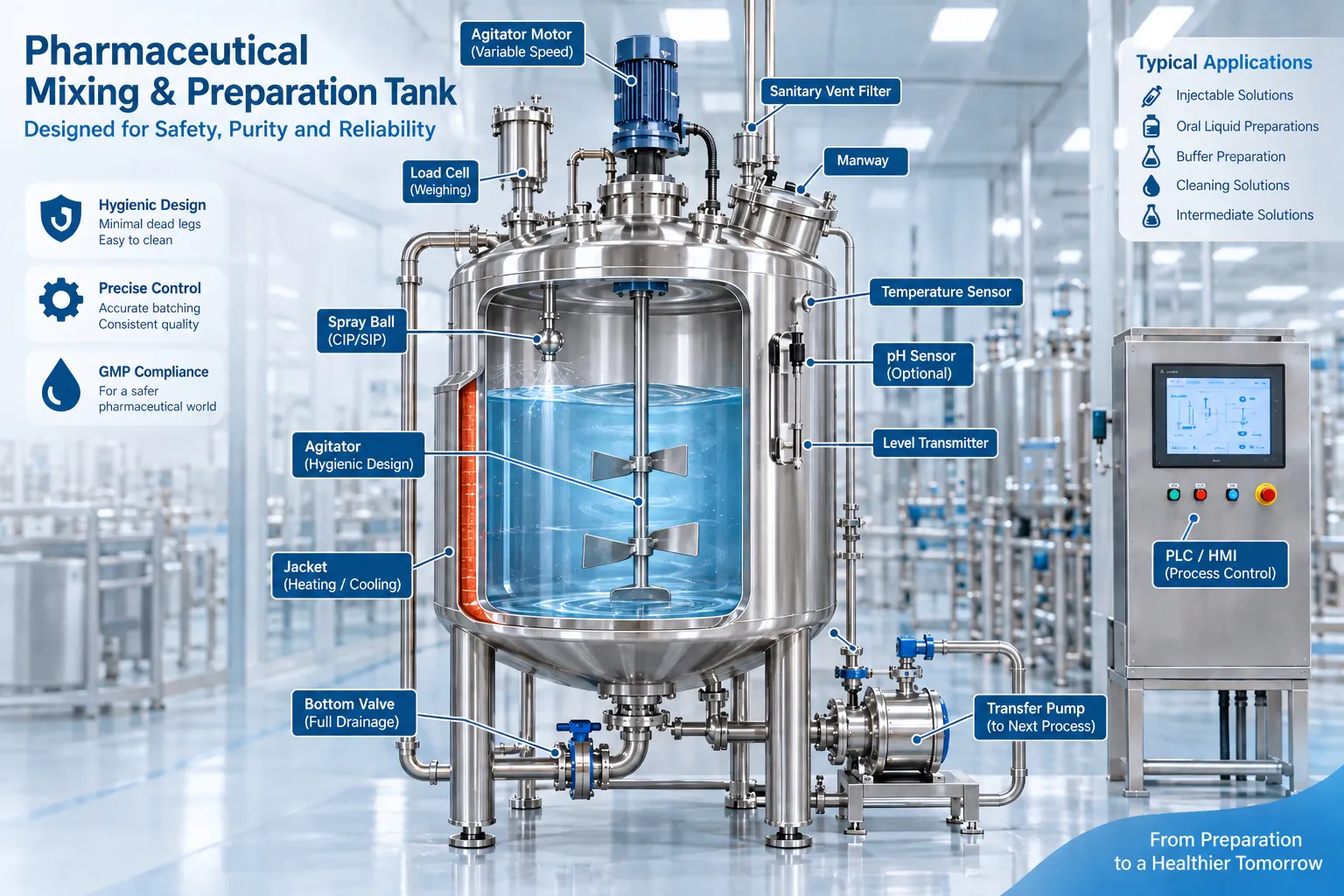
In pharmaceutical manufacturing, a mixing and preparation system is more than a tank equipped with an agitator. It is an integrated process system designed to accurately prepare, dissolve, blend, hold, and transfer liquid formulations under controlled hygienic conditions.
Depending on the application, the system may handle Purified Water (PW), Water for Injection (WFI), active ingredients, excipients, buffers, cleaning solutions, and other process materials.
Compared with mixing equipment used in general industrial applications, pharmaceutical preparation systems require stricter control of materials, surface finish, cleanability, drainability, contamination risks, process repeatability, and documentation.
1. What Is a Pharmaceutical Mixing and Preparation System?
A pharmaceutical mixing and preparation system is designed to prepare a controlled liquid formulation from defined quantities of pharmaceutical-grade water and process ingredients.
Depending on the manufacturing process, several preparation, buffer, and holding vessels may be integrated through sanitary piping, pumps, valves, instrumentation, and automated control.
2. What Is a Pharmaceutical Mixing System Used For?
Pharmaceutical mixing systems can be engineered for different liquid preparation processes, including:
- Injectable solution preparation
- Ophthalmic and otic solution preparation
- Oral liquid manufacturing
- Buffer preparation
- Syrup preparation
- Ingredient dissolution
- Intermediate solution preparation
- Cleaning solution preparation
- Process solution holding and transfer
3. How Does a Pharmaceutical Mixing System Work?
Step 1: Water Charging
Purified Water or WFI is transferred into the preparation vessel. Charging quantity can be controlled using load cells, flowmeters, level transmitters, or PLC-based batch control.
Step 2: Ingredient Addition
Raw materials are introduced according to the manufacturing procedure. Addition may be manual or automated depending on the formulation and production requirements.
Step 3: Mixing and Dissolution
The agitator creates controlled fluid circulation to disperse and dissolve ingredients. Top-entry agitators, bottom-entry agitators, magnetic mixers, or high-shear mixers can be selected according to the process.
Step 4: Heating or Cooling
Jacketed vessels can use plant steam, hot water, chilled water, cooling water, or electric heating. Temperature sensors and automated valves maintain the required process temperature.
Step 5: Final Adjustment
Additional water or ingredients can be added to reach the final batch volume, concentration, pH, or other specified process conditions.
Step 6: Filtration
Where required, the prepared solution is transferred through sanitary filtration before entering a holding vessel or downstream process.
Step 7: Holding and Transfer
The finished solution can be temporarily held under controlled conditions before transfer to filling or downstream production equipment.
4. Typical Pharmaceutical Mixing System Configuration
| Component | Typical Function |
|---|---|
| SS316L Mixing Tank | Product preparation and holding |
| Agitator / Magnetic Mixer | Controlled mixing and dissolution |
| Heating / Cooling Jacket | Process temperature control |
| Load Cells | Batch weighing and dosing |
| Temperature Sensor | Process temperature monitoring |
| Level Transmitter | Tank level monitoring |
| Sanitary Pump | Solution circulation and transfer |
| Filter Housing | Process or product filtration |
| CIP/SIP Spray Device | Internal cleaning or sterilization |
| PLC/HMI | Process sequence, alarms and automation |
5. Why Are Pharmaceutical Mixing Systems More Stringent?
A general-purpose mixing tank may successfully blend a product while still being unsuitable for pharmaceutical production. Mixing performance alone is not enough.
Product-Contact Material
SS316L stainless steel is commonly selected for pharmaceutical product-contact surfaces because of its corrosion resistance and suitability for hygienic processing.
Internal Surface Finish
Pharmaceutical systems commonly specify controlled internal surface roughness such as Ra ≤ 0.8 μm or Ra ≤ 0.6 μm, depending on project requirements. Electropolishing may also be specified.
Hygienic Piping
Product piping should minimize liquid retention and contamination risks through proper slope, drainability, controlled dead legs, hygienic fittings, sanitary valves, and controlled welding.
6. Cleanability Is Part of the Equipment Design
In pharmaceutical processing, the cleaning strategy should be considered before the mechanical design is finalized.
Depending on the process, the preparation system can also support hot-water sanitization or SIP. Spray devices, valves, pumps, instruments, filters, and piping should all be considered within the cleaning path.
7. Mixing Performance and Process Repeatability
The agitator should not be selected only according to motor power. Engineering selection should consider:
- Tank and working volume
- Minimum operating volume
- Product viscosity and density
- Required mixing time
- Powder dissolution requirements
- Shear sensitivity
- Operating temperature
- Required circulation pattern
Variable-frequency control allows different agitation speeds during ingredient addition, dissolution, holding, and transfer.
8. Automation and Process Control
A PLC/HMI system can automate and monitor:
- Water charging
- Agitator speed
- Ingredient addition sequence
- Heating and cooling
- Transfer pumps and valve positions
- Tank levels
- Filtration
- CIP sequences
- Alarms and interlocks
Where required, the control architecture can also incorporate recipe management, user access levels, alarm history, batch records, and audit-trail functions.
9. Pharmaceutical vs. General Industrial Mixing Systems
| Design Area | Pharmaceutical System | General Industrial System |
|---|---|---|
| Contact Material | Commonly SS316L | Various industrial materials |
| Surface Finish | Controlled hygienic finish | Usually less stringent |
| Piping | Hygienic and drainable | Primarily functional |
| Dead Legs | Strictly controlled | Less emphasis |
| Cleaning | CIP/SIP considered in design | Often manual or simplified |
| Automation | Batch control may be required | Basic control often sufficient |
| Documentation | Extensive project documentation | Usually less extensive |
10. Integration with Pharmaceutical Water Systems
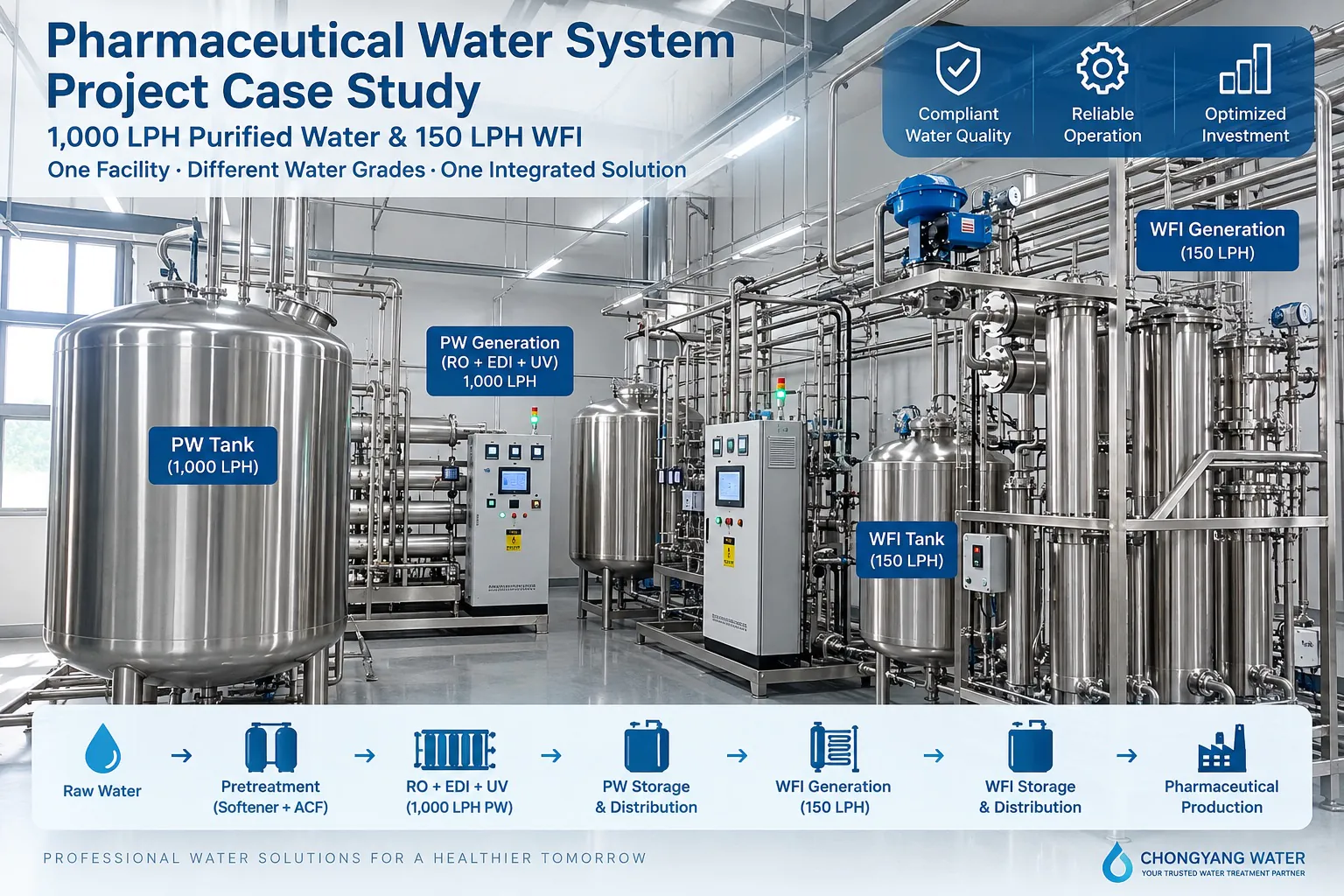
One major advantage of an integrated pharmaceutical utility and preparation solution is the connection between the water-generation system and the mixing process.
This integrated approach allows PW/WFI demand, batch volume, cleaning consumption, peak demand, storage capacity, and production schedules to be considered as one complete process.
FAQ
What material is normally used for pharmaceutical mixing tanks?
SS316L is commonly used for product-contact surfaces. The exact material and finish depend on the formulation and project specification.
What is the difference between a pharmaceutical mixing tank and a normal stainless-steel tank?
A pharmaceutical tank places greater emphasis on hygienic surface finish, drainability, sanitary valves, cleanability, controlled welding, instrumentation, and documentation.
Can a pharmaceutical mixing system use Purified Water?
Yes. Many preparation processes use PW, while more critical applications may require WFI depending on the product and manufacturing process.
Can the mixing tank be heated and cooled?
Yes. Jacketed tanks can use steam, hot water, cooling water, chilled water, or electric heating depending on the process.
Can CIP and SIP be integrated?
Yes. CIP and/or SIP functions can be incorporated with suitable spray devices, sanitary piping, valves, instrumentation, and automation.
Conclusion
A pharmaceutical mixing and preparation system is not simply a stainless-steel tank and agitator. It is a controlled process system integrating water charging, ingredient addition, mixing, temperature control, filtration, holding, transfer, cleaning, instrumentation, and automation.
The major difference from general industrial mixing equipment lies in the level of hygienic engineering. Material selection, surface finish, drainability, dead-leg control, sanitary valves, welding, cleaning strategy, instrumentation, and documentation must all be considered from the beginning of the project.
For pharmaceutical manufacturers, integrating the preparation system with PW or WFI generation, storage, and distribution creates a complete process solution from pharmaceutical-grade water production through formulation preparation and final transfer.
Need a Pharmaceutical Mixing and Preparation System?
We provide customized pharmaceutical mixing tanks, solution preparation systems, buffer tanks, PW/WFI storage and distribution systems, sanitary filtration units, CIP/SIP systems, and integrated pharmaceutical water systems.
Send us your batch volume, product type, required water grade, viscosity, operating temperature, heating/cooling requirements, filtration requirements, CIP/SIP requirements, and automation level. Our engineering team can configure the preparation tank, mixing method, sanitary piping, instrumentation, and control system around your actual process.
Request a Mixing System Proposal →More Posts