
Blog
From Raw Water to Pharma Grade Water Quality
Introduction
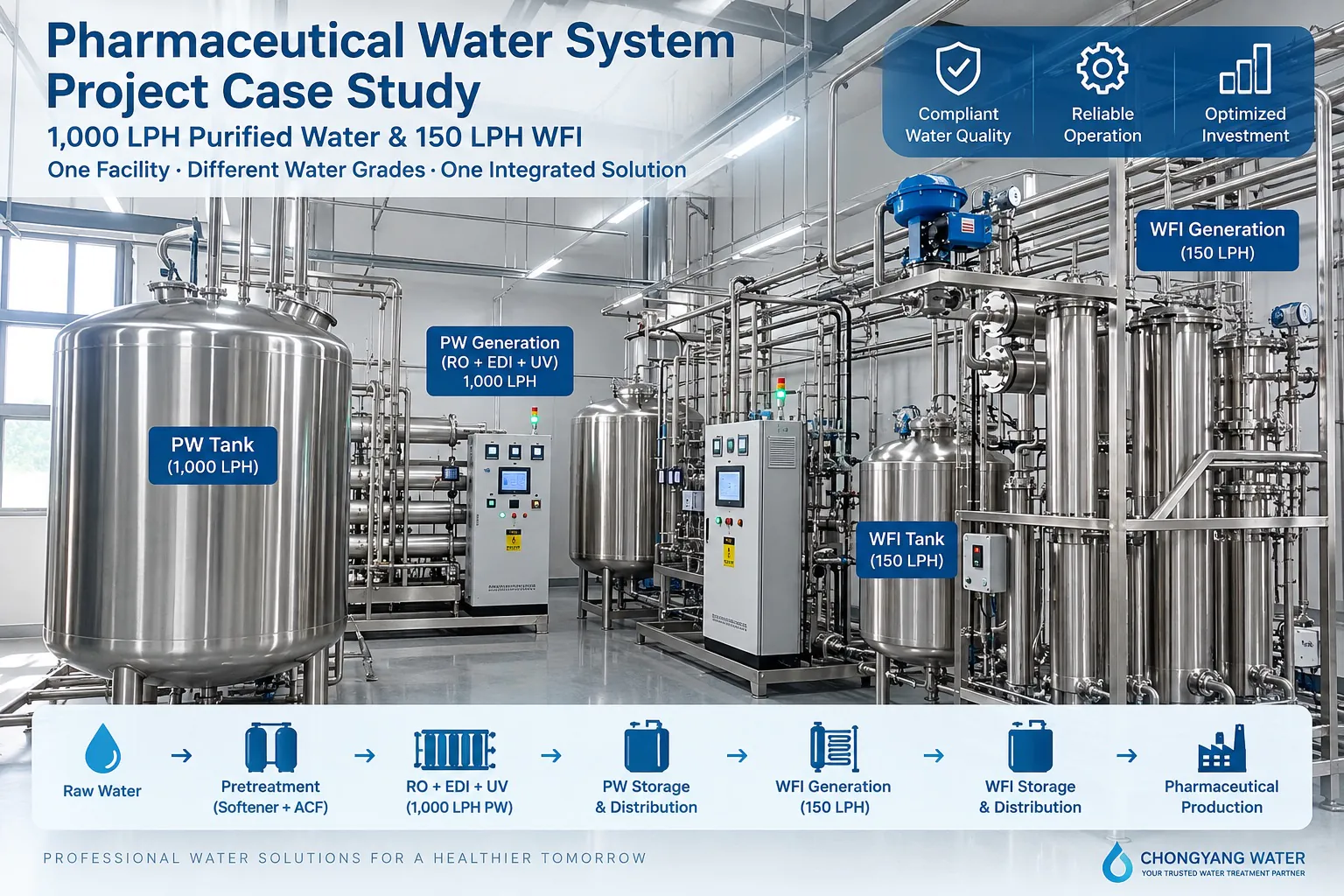
Pharmaceutical water quality is not achieved by a single piece of equipment. It is created through a complete treatment chain that starts with raw water, removes physical, chemical, and microbiological contaminants, produces Purified Water (PW), Water for Injection (WFI) where required, and then stores and distributes both water grades to the final points of use.
For pharmaceutical manufacturers, the engineering challenge is not only to achieve the required water quality at the outlet of the generation skid. The complete system must also maintain that quality during storage, circulation, sanitization, and delivery.
Each stage has a different function, and failure at one stage can affect the reliability of the entire pharmaceutical water system.
1. Starting with Raw Water
Raw water may come from municipal water, groundwater, surface water, well water, or pre-treated industrial water.
Common contaminants include:
- Suspended solids and turbidity
- Calcium and magnesium hardness
- Iron and manganese
- Chlorine
- Silica and chloride
- Organic compounds
- Microorganisms
- Dissolved salts
Before designing a pharmaceutical purified water system, a detailed raw-water analysis should be reviewed.
2. Pretreatment: Protecting the Purification System
Pretreatment protects downstream RO membranes, EDI modules, pumps, and hygienic equipment.
Multimedia Filtration
Multimedia filtration removes suspended solids, sediment, turbidity, and larger particles, reducing solids loading on downstream equipment.
Activated Carbon Filtration
Activated carbon is commonly used to reduce free chlorine and organic compounds. Chlorine removal is important because oxidizing disinfectants can damage many RO membrane materials.
Water Softening
Softening reduces calcium and magnesium hardness, helping prevent mineral scale on RO membranes, heat exchangers, WFI evaporators, and piping surfaces.
3. Reverse Osmosis: The Main Purification Barrier
Reverse osmosis is one of the core technologies used in pharmaceutical purified water generation.
RO membranes remove a high percentage of:
- Dissolved salts
- Hardness
- Silica
- Organics
- Colloids
- Microorganisms
For higher water-quality stability, pharmaceutical plants frequently use double-pass RO to achieve lower conductivity, reduced ionic loading, and better control of source-water variation.
4. EDI: Polishing RO Water into High-Quality Purified Water
After double-pass RO, Electrodeionization (EDI) may be used as the final ionic polishing stage.
EDI combines ion-exchange resin, ion-selective membranes, and direct electrical current to continuously remove residual ions from RO permeate.
Benefits include stable low conductivity, continuous operation, reduced chemical handling, lower regeneration waste, and more consistent purified water production.
5. Purified Water Generation and Quality Control
Once the water passes through the required purification stages and meets applicable requirements, it becomes pharmaceutical Purified Water.
A complete PW generation skid may include:
- Pretreatment
- Double-pass RO
- EDI
- Conductivity monitoring
- Flow and pressure monitoring
- Temperature monitoring
- PLC/HMI control
- Automatic flushing and alarms
Depending on project requirements, online TOC, pH, ORP, hardness, or chlorine monitoring may also be incorporated.
6. From Purified Water to Water for Injection
Purified Water is often the feed water for a Water for Injection system.
WFI is traditionally generated using technologies such as multi-effect distillation or vapor compression distillation.
During multi-effect distillation, purified water is heated, evaporated, separated from non-volatile impurities, and condensed as high-purity WFI.
7. Why Purified Water Should Feed the WFI Generator
Using stable purified water as WFI feed helps reduce:
- Hardness loading
- Silica loading
- Chloride concentration
- Scaling tendency
- Corrosion risk
- Cleaning frequency
- Conductivity fluctuation
8. Pharmaceutical Water Storage
Producing high-quality water is only the first half of the system. If water is stored incorrectly, quality can deteriorate.
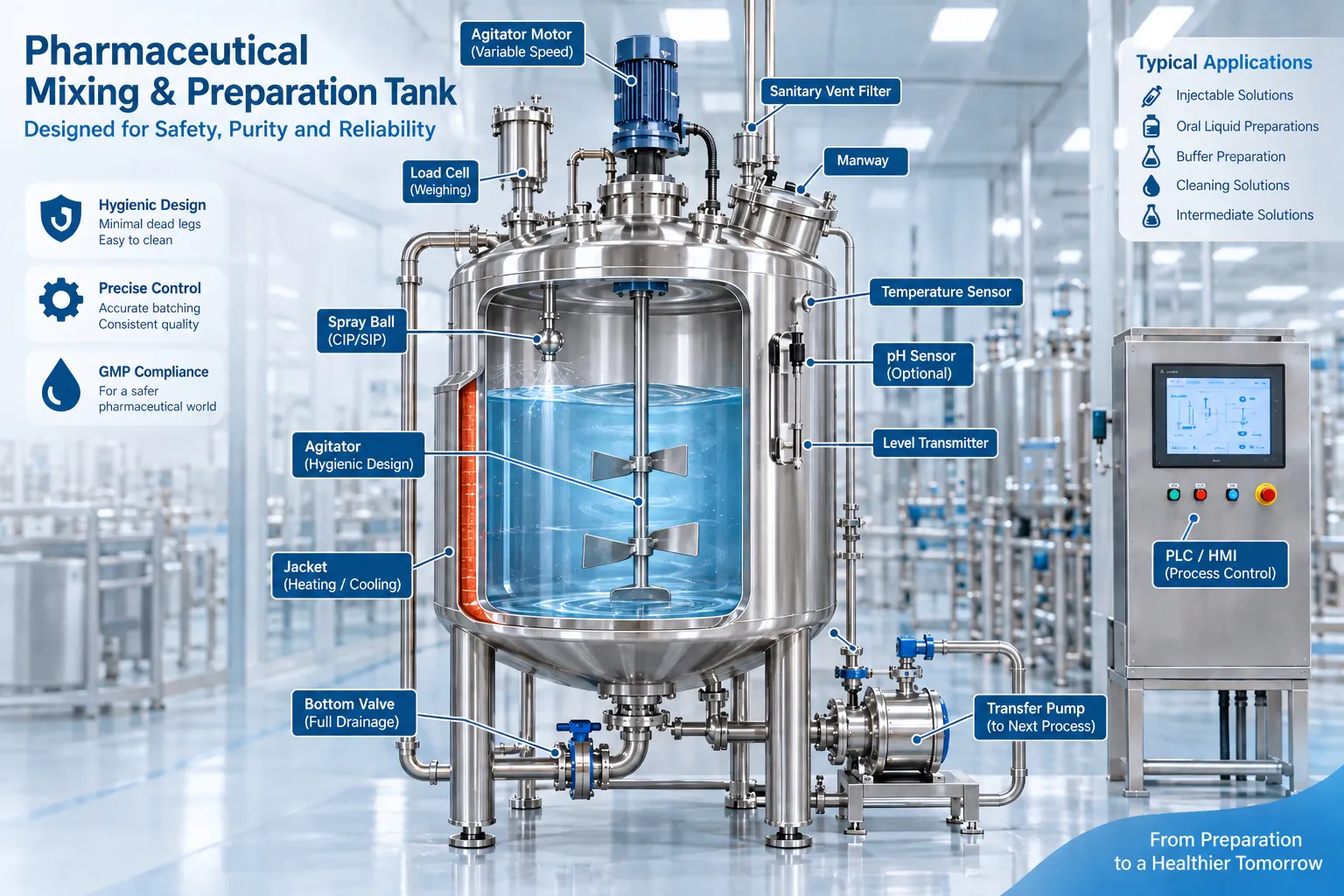
Typical pharmaceutical storage tanks are designed with:
- SS316L product-contact surfaces
- Hygienic internal finish
- Spray ball
- Sanitary vent filter
- Level transmitter
- Temperature monitoring
- Drainable geometry
- Hygienic valves
Tank size should be based on production demand, peak hourly use, daily consumption, generation capacity, and required operating reserve.
9. Purified Water Distribution
Purified Water is normally distributed through a continuously circulating sanitary loop.
Important design features include SS316L piping, continuous circulation, hygienic diaphragm valves, proper pipe slope, low dead-leg design, and return-line monitoring.
10. WFI Storage and Distribution
WFI distribution systems require tighter hygienic control than general utility-water systems.
Key considerations include SS316L hygienic piping, continuous recirculation, insulation, proper slope, controlled dead legs, return-temperature monitoring, and conductivity monitoring.
11. The Final Point of Use
The complete pharmaceutical water system exists to deliver compliant water to the actual production process.
Typical PW Points of Use
- Equipment washing
- CIP preparation
- Oral liquid production
- Non-sterile formulation
Typical WFI Points of Use
- Sterile formulation
- Injectable-product processing
- Critical final rinsing
- Sterile process preparation
The distribution loop should be sized according to the number of users, maximum simultaneous demand, peak hourly consumption, required return velocity, and pressure at remote points.
Key Engineering Considerations
| System Stage | Main Engineering Objective |
|---|---|
| Raw Water Analysis | Understand source-water risks |
| Pretreatment | Protect RO and downstream equipment |
| RO | Remove dissolved and suspended contaminants |
| EDI | Polish residual ionic impurities |
| PW Storage | Maintain purified water quality |
| WFI Generation | Produce water for critical applications |
| Distribution Loop | Maintain water quality during circulation |
| Point of Use | Deliver required flow, pressure, and quality |
On mobile devices, swipe horizontally to view the full table.
FAQ
What is the most common process for producing pharmaceutical purified water?
A common modern process is pretreatment followed by double-pass RO and EDI, although the final design depends on source-water quality and project requirements.
Can raw water be converted directly into WFI?
In most pharmaceutical systems, raw water is first treated into Purified Water, and PW is then used as feed water for the WFI generation system.
Why is EDI used after RO?
EDI removes residual ions from RO permeate and provides stable low-conductivity water without routine chemical regeneration.
Is Purified Water the same as WFI?
No. PW and WFI are different pharmaceutical water grades with different quality requirements and applications.
Why does pharmaceutical water need continuous circulation?
Continuous circulation reduces stagnation and helps control microbial growth in storage and distribution systems.
What material is normally used for pharmaceutical water piping?
SS316L stainless steel is commonly used for pharmaceutical PW and WFI product-contact piping.
Conclusion
Transforming raw water into pharmaceutical-grade water is a multi-stage engineering process.
Each stage protects the next. Pretreatment protects RO. RO reduces the main contaminant load. EDI stabilizes purified water quality. WFI generation provides water for critical use. Hygienic storage and continuous distribution maintain the quality already achieved.
For pharmaceutical manufacturers, the most reliable strategy is to design the complete water system as one integrated utility rather than selecting individual machines separately.
Need a Complete Pharmaceutical Water System?
We design and manufacture integrated Purified Water, Water for Injection, storage and distribution, RO + EDI, multi-effect distillation, and sanitary piping systems for pharmaceutical applications.
Send us your raw-water analysis, required PW and WFI capacities, daily consumption, number of points of use, loop length, operating temperature, and water-quality requirements, and our engineering team can recommend a suitable complete system configuration.
Request a Pharmaceutical Water System Proposal →More Posts